




Experience vs Expertise: Which Matters More When Hiring?

When hiring, experience is one of the easiest things to measure.

A candidate has five years in the industry. Another has ten. Someone else has worked with similar clients, held a comparable title, or spent years using the same systems.

On paper, the decision can seem straightforward: more experience should mean a better candidate. But years spent doing a job do not necessarily tell you how well someone understands it.

That distinction matters because businesses aren’t really hiring years. They’re hiring capability.

Why Employers Still Rely on Experience

If someone has already worked in a similar position, employers can reasonably assume they have encountered at least some of the challenges associated with the role.

Experience can indicate familiarity with:

  • Industry terminology
  • Common processes and workflows
  • Relevant software and systems
  • Client expectations
  • Workplace procedures
  • Typical challenges and problems
  • Industry-specific regulations


It can also reduce the amount of time required to bring someone up to speed. For roles where mistakes can be costly, having someone who already understands the environment can be particularly valuable.

This is why experience remains an important part of recruitment.

However, experience is only a proxy for capability. Ten years in a role does not automatically mean someone has ten years of expertise.

A candidate may have performed largely the same responsibilities for years without developing significantly beyond them. Another candidate may have had fewer years in the industry but gained experience across more complex situations, developed specialised knowledge or taken on greater responsibility.

Experience and Expertise are Not the Same Thing

Businessman shaking hand of female coworker during company meeting.
The best hiring decisions look beyond tenure and assess what a candidate can actually do.

Experience is generally about what someone has been exposed to and how long they’ve been doing it.

Expertise is about what someone has learned to do exceptionally well as a result. The two often develop together, but they don’t have to.

Consider two employees working in the same role for eight years.

One has performed the same process repeatedly, becoming extremely efficient but rarely taking on more complex responsibilities.

The other has spent those eight years learning new systems, handling difficult cases, developing specialist knowledge, mentoring colleagues, and finding ways to improve the process itself.

Both have eight years of experience. Their expertise may be very different.

This is why hiring based purely on tenure can produce misleading results. A candidate’s career history tells you where they have been. It doesn’t necessarily tell you what they are capable of doing now.

Insight

The Australian Bureau of Statistics recorded 329,500 job vacancies in May 2026, even after vacancies fell 2.1% over the quarter. At the same time, 35% of Australian businesses reported experiencing a skills shortage in 2024–25. Among businesses experiencing skills shortages, 57% said specialist skills or knowledge were required, making it the most commonly reported reason for the shortage.

Why Employers Still Rely So Heavily on Years of Experience

Business colleagues banner concept with copy space.
Two people can have the same number of years in a role but develop very different levels of expertise.

There is a practical reason experience remains such a common hiring requirement: it’s easy to screen for.

“Five years’ experience in financial services” can be included in a job advertisement, filtered during recruitment, and discussed during an interview.

Expertise is harder to quantify.

How do you measure someone’s ability to interpret complex information Judgement? Their attention to detail? Ability to identify problems before they become costly? Their understanding of a particular client segment?

These qualities require deeper assessment. The result is that businesses can sometimes use experience as a shortcut for determining competence.

This is particularly common when hiring for roles where the cost of a poor appointment is high. Employers want someone who can contribute quickly, so they naturally look for candidates with a long track record.

But there is a difference between being familiar with the work and being highly capable at the work. The best hiring decisions consider both.

When Experience Has the Advantage

That does not mean expertise should always outweigh experience. There are situations where previous experience provides a significant advantage.

Financial services is a good example. In regulated roles, prior industry exposure can shorten the time required to understand the operating environment, compliance obligations, client expectations and escalation pathways.

But in Australia, experience alone is not always sufficient. For relevant providers giving personal advice to retail clients, professional standards include legislated qualification requirements, with existing relevant providers generally required to meet the qualifications standard from 1 January 2026 to continue providing personal advice to retail clients.

For an advice practice, this means assessing both context and competence.

Has the candidate worked in an Australian advice environment?

Do they understand the technical requirements of the role?

Do they have the appropriate qualifications?

Do they understand current regulatory expectations?

Can they exercise sound judgement when dealing with clients and sensitive information?

In these situations, relevant experience and expertise work together.

For example, experience in an Australian financial advice environment may provide familiarity with:

  • Australian financial-advice terminology, workflows and compliance processes
  • Client expectations and communication styles
  • Common advice practice workflows
  • Relevant software and platforms
  • Documentation and administration requirements
  • Escalation procedures
  • The practical application of regulatory requirements


A candidate with highly specialised technical knowledge but no understanding of the environment may require significantly more support.

This is why the answer is not simply “expertise over experience.”

The question is whether the candidate has the right experience and the right expertise for the job.

When Expertise Matters More

Two candidates applying for the same job different experience level.
A candidate with fewer years of experience may still be the stronger hire if they have deeper expertise in the specific function your business needs.

There are also roles where deep expertise can outweigh years of general experience.

Consider another business choosing between two candidates.

Candidate A has ten years of broad administrative experience but has only limited exposure to the specific systems and processes the business relies on.

Candidate B has five years of experience but has spent most of that time specialising in the exact function the business needs.

The second candidate may be able to contribute more quickly despite having fewer years on their CV.

This becomes increasingly important as roles become more specialised. A business may not need someone who has simply “worked in finance” for ten years. It may need someone with specific expertise in management accounting, payroll, financial reporting, paraplanning, CRM administration, or Australian tax processes.

The more precise the problem, the more important relevant expertise becomes.

The Technology Factor is Changing the Equation

Technology is also changing how businesses think about experience and expertise.

AI is making the distinction more visible, but not because experience no longer matters.

In 2024–25, 12% of Australian businesses reported using AI, up from just 1% in 2021–22. Adoption was considerably higher in Financial and Insurance Services, where 24% of businesses reported using AI.

AI can now assist with tasks such as drafting content, summarising information, organising data and automating parts of repeatable workflows.

But that does not mean professional work has simply been replaced.

Jobs and Skills Australia has found that generative AI is more likely to augment jobs than replace them, although the impact varies depending on the occupation, industry, region and worker group.

The human value increasingly lies in knowing how to use the technology effectively.

An employee may be able to use AI to produce a first draft, for example. But someone still needs to determine whether the information is accurate, whether the output is appropriate and whether there are risks or exceptions that the technology has missed. That requires judgement.

It also requires expertise. This changes what employers should assess during recruitment.

Rather than only asking whether a candidate has used a particular system or performed a particular task many times, employers should consider whether they can:

  • Use technology appropriately
  • Identify inaccurate or unreliable outputs
  • Protect sensitive information
  • Recognise exceptions and potential risks
  • Apply professional judgement
  • Adapt when technology or processes change
  • Take responsibility for the final outcome


The question is gradually shifting from:

“How many years has this person done the job?” into  “What can this person understand, evaluate and solve that requires genuine professional capability?”

How to Assess Expertise During Recruitment

Horizontal portrait of people sit in queue, have pleasant conversation with each other.
Ask candidates to demonstrate how they think, solve problems, apply their knowledge and respond when circumstances change.

The easiest way to distinguish experience from expertise is to stop relying exclusively on a CV. 

Years of experience can establish a baseline, but they don’t necessarily show how well someone applies what they have learned.

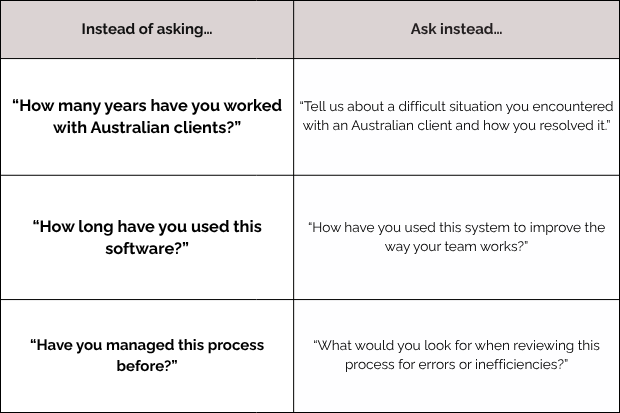
A better approach is to ask questions that require candidates to demonstrate their judgement, problem-solving ability and understanding of the work.

Table comparing questions to ask during hiring.

Good recruitment questions should therefore explore more than how long someone has performed a task. They should uncover:

  • Depth: How well do they understand the function?
  • Application: Can they use that knowledge in real situations?
  • Judgement: Can they make sound decisions when circumstances change?
  • Adaptability: Can they learn new systems and approaches?
  • Context: Do they understand the industry and environment in which the work takes place?


These qualities provide a much clearer picture of capability than a number of years on a resume.

Choose the Right Candidate for Your Business

For some positions, experience is essential. For others, specialised expertise can be far more valuable than additional years of general experience. The mistake is assuming that one automatically proves the other.

A candidate with ten years of experience may be exactly what your business needs. A candidate with five years may have developed deeper expertise and be better suited to the role.

The best hiring decisions look beyond tenure and assess the capability the business actually needs.

At Advice2Talent, we help Australian businesses look beyond the CV to identify talent based on relevant experience, technical capability, industry knowledge and role fit. 

Whether you’re hiring locally or building an offshore team, the goal isn’t simply to find someone who has done the job before. It’s to find someone who can do the job well, adapt as the business changes, and create value from day one.

Articles You Might Also Like​

Full shot woman at work with coffee cup
Company Insights
Carolina Castillo

How AI Will Impact Entry-Level Jobs in Australia

AI isn’t eliminating entry-level jobs—but it is changing how careers begin. Learn how AI is reshaping graduate roles in Australia, the skills employers now value most, and why human judgement is becoming more important than ever.

Read More »
Virtual Assistants and Remote Work
Carolina Castillo

Why Your Best Employees May Be Burning Out Mid-Year

Burnout isn’t always obvious. Learn why your highest-performing employees are often the most at risk, the warning signs managers miss, and how better workload design can help prevent burnout before it impacts retention and performance.

Read More »

Leave a Reply

Your email address will not be published. Required fields are marked *