


Every professional starts somewhere.
For decades, entry-level roles have followed a familiar pattern. Graduates and junior employees begin by handling routine work – processing documents, updating CRM systems, preparing first drafts, conducting research, or managing administrative tasks.
Artificial intelligence is changing that pathway. From drafting reports and summarising meetings to analysing data and automating workflows, AI is now capable of completing many of the tasks that have historically been assigned to junior employees.
Unsurprisingly, this has sparked concerns that entry-level jobs may disappear altogether.
Recent Australian research suggests AI is not causing widespread job losses. Instead, it is reshaping the work performed within many occupations – particularly those built around routine, rules-based processes.
If AI increasingly handles the work that graduates once learned from, how will the next generation develop the experience needed to become tomorrow’s advisers, accountants, brokers, managers, and leaders?
AI is Not Eliminating Entry-Level Jobs
The conversation around AI and employment is often dominated by headlines predicting mass job losses. Yet Australia’s most recent evidence paints a different picture.
The Australian Government’s landmark AI and Employment 2026 report found no evidence of broad-based employment declines directly caused by AI, even in occupations considered highly exposed to automation.
In fact, employment among Australians aged 20 to 24 has continued to grow slightly faster than employment for older workers since late 2022, challenging the assumption that graduate opportunities are rapidly disappearing.
Instead, researchers found something more subtle.
Occupations built around routine, repeatable work like telemarketing, clerical support and certain administrative roles are beginning to experience slower employment growth than less AI-exposed occupations.
Rather than replacing entire professions, AI is gradually reducing the amount of repetitive work within them.
Insight
Jobs and Skills Australia estimates that only around 4% of Australian workers are employed in occupations with high automation potential.
By comparison, approximately 79% work in occupations that are more likely to be augmented by AI than replaced, meaning technology will change how people work far more often than it eliminates their roles entirely.
Junior Roles are Becoming AI's Testing Ground
Although AI is influencing almost every profession, its impact is most visible in entry-level positions because these roles often involve structured, process-driven work.
Jobs and Skills Australia has consistently identified occupations such as general clerks, receptionists, accounting clerks, bookkeeping support, registry clerks, and administrative assistants among those with the greatest automation potential.
The Federal Government’s 2026 employment analysis similarly notes that administrative and clerical occupations are among the first to show signs of slower employment growth associated with AI adoption.
These findings closely mirror the kinds of roles many graduates enter after university.
- Junior accountants reconcile transactions and prepare working papers.
- Administrative assistants organise documentation and maintain records.
- Mortgage processing teams update lender portals and collect supporting documents.
- Paraplanners prepare research and draft advice documents.
- Customer service teams respond to common enquiries using established procedures.
None of these responsibilities are low value. They are essential to how businesses operate.
The common characteristic is that many of these tasks follow consistent rules, making them ideal candidates for automation.
Rather than eliminating the role itself, AI is changing what employers expect entry-level employees to contribute.
Is AI Breaking the Traditional Career Ladder?
Routine execution is becoming increasingly automated, while human contribution is moving towards oversight, interpretation, quality assurance, and decision-making.
For decades, professional careers have developed through repetition.
Graduates completed administrative work. Junior staff drafted reports that senior colleagues reviewed. Associates sat in client meetings, observed experienced professionals, and gradually took on greater responsibility. Through repetition, they built confidence, judgement, and industry knowledge.
UNSW researchers have described this as a growing concern in the age of AI. If artificial intelligence performs much of the routine work that once served as a professional training ground, organisations cannot assume experience will develop naturally. The career ladder itself begins to change.
It means employers must become far more intentional about how they develop them.
Mentoring, structured learning, shadowing senior staff, project-based work, and progressively challenging assignments become increasingly important because experience can no longer rely solely on completing repetitive tasks.
The Australian Government’s AI employment report echoes this concern, warning there is little “luxury of time” for organisations to prepare workers for deeper workforce transformation.
In other words, AI may save time – but businesses must decide how that time is reinvested.
AI Raises the Value of Human Skills
As AI becomes more capable, the skills that differentiate people become even more valuable.
Research from Microsoft’s 2026 Work Trend Index Australia found that 63% of Australian AI users believe they are producing work they could not have completed just a year earlier, demonstrating AI’s potential to significantly increase productivity.
But when asked which skills matter most in an AI-enabled workplace, Australian professionals consistently identified critical thinking and quality control of AI outputs among the most important human capabilities.
As AI handles more execution work, people increasingly become responsible for asking better questions, identifying risks, interpreting information, and building trusted relationships.
What Employers Need to Rethink About Entry-Level Hiring
The biggest challenge facing employers may not be adopting AI – it may be redesigning work.
Recent Australian research suggests organisations are moving faster in using AI than in restructuring jobs around it.
Microsoft’s 2026 Australian findings revealed that 68% of workers worry they’ll fall behind if they don’t build AI capability, yet only 28% believe their organisation has a clear AI strategy, while just 13% feel they are rewarded for redesigning work rather than simply delivering short-term outputs.
Rather than viewing AI as a replacement for graduate recruitment, businesses should reconsider how entry-level roles are structured.
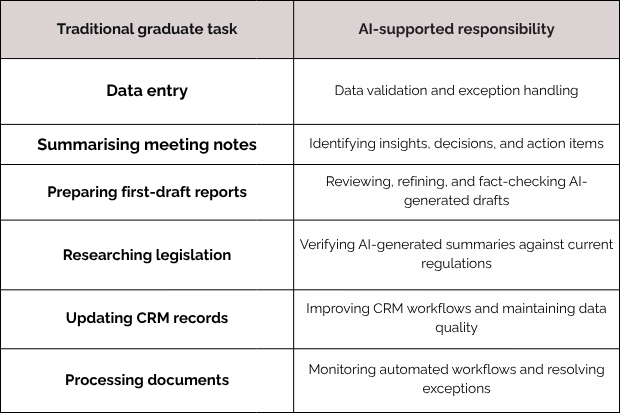
For example, junior professionals might spend less time producing reports from scratch and more time reviewing AI-generated outputs for quality, identifying client implications, and recommending next steps.
Administrative staff may shift from manual processing towards monitoring automated workflows, resolving exceptions, and improving systems.
Equally important is investing in AI literacy. Graduates should understand how to use AI responsibly for research, drafting, and analysis while recognising its limitations, biases, and the need for human verification.
What Graduates Should Focus On in an AI-Driven Workplace

For graduates and early-career professionals, AI shouldn’t be viewed as a reason to avoid certain industries. Instead, it should shape the skills you choose to develop first.
Learning how to use AI effectively is quickly becoming an employability advantage, much like proficiency with spreadsheets or cloud software became essential in previous generations.
But even so, the graduates who thrive will be those who know when to rely on AI and when to rely on their own judgement.
- Become AI-literate. Learn how to use AI tools for research, drafting, data analysis, and productivity within your industry, while understanding their limitations.
- Strengthen critical thinking. AI can generate answers quickly, but you’ll be expected to evaluate whether those answers are accurate, relevant, and appropriate.
- Develop communication and relationship skills. Writing clearly, presenting ideas confidently, collaborating with colleagues, and building client trust remain difficult to automate.
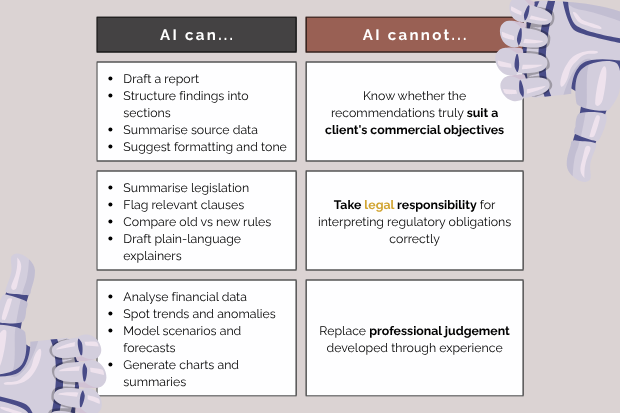
- Build commercial and industry knowledge. AI can surface information, but understanding how it applies to Australian regulations, client objectives, or business strategy requires context and experience.
- Practise verification and quality control. Make it a habit to validate AI-generated content against legislation, source documents, company policies, or client data before relying on it.
- Stay curious and adaptable. Professionals who continue learning will be better positioned to take advantage of new opportunities as roles continue to change.
Graduates who learn to work alongside AI – rather than compete against it – are likely to build expertise faster than previous generations ever could.
The Future of Entry-Level is More Strategic
Artificial intelligence is undoubtedly changing how careers begin.
Routine administrative work will continue to decline as automation becomes more capable. But that does not mean entry-level professionals are becoming obsolete.
It means businesses must rethink how experience is developed, how graduate roles are designed, and how technology complements rather than replaces human capability.
The organisations that thrive won’t simply be those adopting AI the fastest. They’ll be the ones creating workplaces where technology removes repetitive work while people spend more time learning, solving problems, building relationships, and making better decisions.
At Advice2Talent, we believe Australia’s future workforce isn’t AI or people—it’s AI supporting people.
We help businesses build AI-ready teams by combining skilled onshore and offshore talent with smarter workforce design, allowing technology to handle repetitive tasks while professionals focus on the high-value work that drives long-term growth.
Articles You Might Also Like

How AI Will Impact Entry-Level Jobs in Australia
AI isn’t eliminating entry-level jobs—but it is changing how careers begin. Learn how AI is reshaping graduate roles in Australia, the skills employers now value most, and why human judgement is becoming more important than ever.

Why Your Best Employees May Be Burning Out Mid-Year
Burnout isn’t always obvious. Learn why your highest-performing employees are often the most at risk, the warning signs managers miss, and how better workload design can help prevent burnout before it impacts retention and performance.

Should You Change Jobs or Stay Put? Understanding Job Hopping vs Job Hugging
Should you stay with your current employer or look for a new opportunity? This guide explores the differences between job hopping and job hugging, helping professionals make informed career decisions while giving employers valuable insights into employee retention.

Are Your Labour Costs Driving Profit or Inefficiency This EOFY?
Most EOFY conversations focus on tax deductions and refunds. But what if the bigger profitability issue is hiding in your labour costs? Learn how rising employment expenses, administrative bottlenecks, and inefficient team structures may be costing your business more than you realise.

How to Build Team Culture With Offshore and Remote Teams
Building a strong culture with offshore and remote teams takes more than workflows and productivity metrics. From team outings and company events to recognition and connection, discover how businesses can improve engagement, retention, and performance by creating a workplace people genuinely want to be part of.

What Payday Super Means for Financial Advisers and Business Owners
The new Payday Super rules will require employers to pay super alongside wages from July 2026. Discover what the changes mean for compliance, cash flow, payroll processes, and business operations.