


Work Abroad Or Become A Virtual Assistant? How A VA Career Can Open Global Opportunities
For years, the traditional path to earning an international salary involved relocating overseas, whether to Australia, New Zealand, the US, or the UK. But remote work has rewritten the rules.
In 2026, more than 1.3 million Filipinos work as remote assistants – the largest VA talent pool globally – while 36% of Australians now usually work from home at least part of the week. Instead of moving abroad, professionals are increasingly choosing to become virtual assistants (VAs) and work directly with international businesses from home.greatplacetowork.com+1
This shift is especially pronounced in the Philippines, where monthly VA applications more than doubled in the first half of 2026 (from 10,857 in January to 23,874 in June), even as only about 0.2% of applicants are hired.
What Does a Virtual Assistant Do?
Virtual assistants today handle far more than basic admin. In 2026, only 26% of VA roles cover a single task type; most are hybrid roles spanning multiple functions.
Common VA responsibilities now include:
- Calendar and email management
- Customer service and client communications
- Data entry, reporting, and CRM updates
- Social media management and content creation
- Recruitment support and onboarding coordination
- Bookkeeping, BAS support, and financial administration
- Project coordination and workflow optimisation
- Executive assistance and paraplanning support
In Australia’s financial advice sector specifically, offshore outsourcing now commonly covers financial planning administration, paraplanning, client onboarding, fee consent tracking, and SOA/ROA preparation.
How to Become a Virtual Assistant
VA careers remain accessible because many professionals already have transferable skills. The typical pathway involves:
- Identify Your Existing Skills – Admin, customer service, sales support, marketing, bookkeeping, or project coordination all translate well.
- Choose a Niche – Specialist VAs earn more. In-demand niches include finance, recruitment, healthcare, legal, and tech.
- Build Relevant Experience – Freelance projects, remote contracts, and support roles strengthen your portfolio.
- Apply for Remote Opportunities – Many Australian and global firms now hire remote staff overseas, especially from the Philippines.
Can Being a Virtual Assistant Get You a Job Abroad?
Yes. Nowadays, “working abroad” no longer means needing to relocate right away. Filipino VAs who work with Australian and other international clients gain exposure to:
- Global business practices and compliance standards
- Industry-specific tools (e.g., Xero, HubSpot, Salesforce, Practice Ignition)
- Cross-cultural communication and remote team workflows
This experience makes them attractive candidates for full-time remote employment, management roles, specialist positions, and even employer-sponsored opportunities.
Can a Virtual Assistant Role Lead to Migration Opportunities?
In some cases, yes! Working closely with an overseas employer can create opportunities that extend beyond remote work.
For example, an Accountant supporting an Australian accounting practice, or a Paraplanner working with an Australian financial advice firm, may develop valuable industry knowledge, build trust with their employer, and become deeply integrated into the business.
Over time, some employers may choose to invest further in high-performing team members through professional development, licensing support, expanded responsibilities, or even sponsorship opportunities where eligible.
An offshore Accountant, for instance, could be supported in obtaining Australian qualifications or experience that strengthen their pathway towards becoming a licensed professional in Australia.
However, it is important to understand that this is a possibility, not a guarantee.
Such opportunities are typically reserved for professionals who consistently demonstrate strong performance, specialised expertise, cultural alignment, and a long-term commitment to the organisation.
Building the right skills, reputation, and relationships is often what turns a remote role into a larger career opportunity.
Think VA Work Has a Salary Ceiling? Think Again.
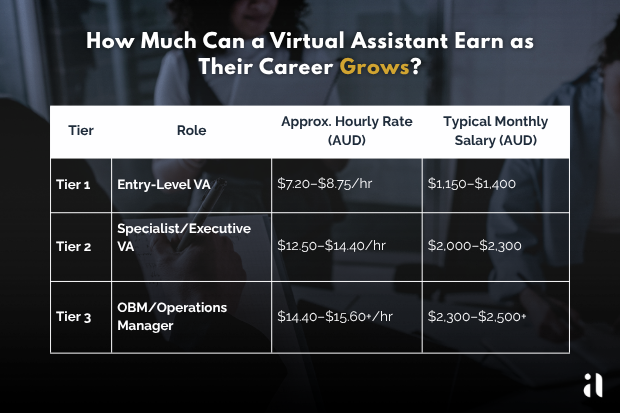
As virtual assistants gain experience, many move beyond administrative support into specialised, client-facing, leadership, or operational roles. Those who focus on developing industry expertise, particularly in sectors such as financial services, marketing, recruitment, or professional services, often see significant career progression over time.
By Years 5 to 7, experienced VAs commonly earn between A$2,000 and A$2,300 per month, while senior Executive Assistants, Team Leads, and Operations Managers can earn A$2,500+ per month depending on their responsibilities and specialisation.
If you’re considering a long-term career as a VA, reviewing current salary benchmarks can help you understand where your skills fit in the market and what progression opportunities may be available as you gain experience.
Understanding the Virtual Assistant Career Path
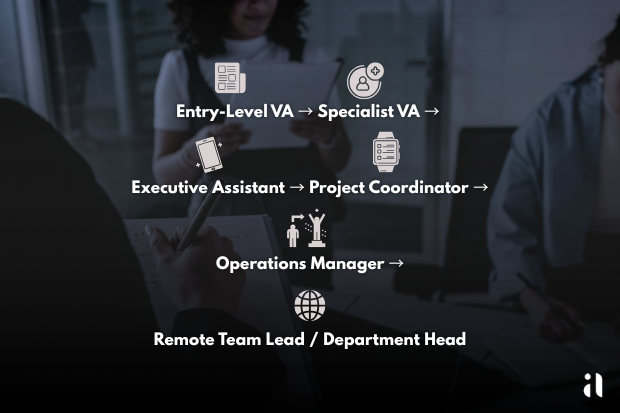
VA work is no longer seen as temporary. Many build decade-long careers remotely.
A typical progression:
Specialisation accelerates earnings: mid-to-senior VAs who develop niches (e.g., legal, bookkeeping, tech, real estate) see 40–60% pay jumps at the transition.
Why Financial Services Businesses are Increasingly Hiring Virtual Assistants
Financial advice firms in Australia are under pressure to do more with fewer staff. Between 2024–2025, local practices reduced admin staff by 8% and paraplanners by 9% due to offshoring.
A VA for financial advisors can handle:
- Appointment scheduling and client communications
- CRM updates and compliance administration
- Document preparation (SOAs, ROAs, annual reviews)
- Database management and fee consent tracking
- Workflow coordination and client onboarding
Time savings: 92% of Australian advisers report saving time on admin tasks using managed accounts and support services; 44% save up to 25% of their time on admin and research.
Cost savings: Hiring an offshore VA can save Australian firms ~73% versus a local hire (e.g., $24,900/year offshore vs $91,407/year loaded local cost). Some mortgage broking firms report saving ~$180,000/year by hiring four offshore staff instead of local hires
Virtual Assistant Jobs Abroad vs Remote International Employment
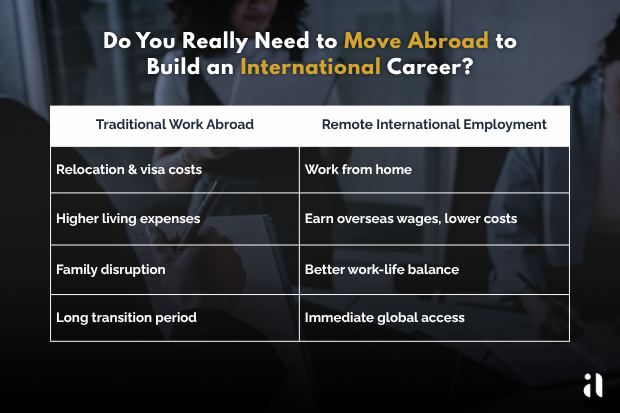
“Virtual assistant jobs abroad” no longer requires relocation. Modern international employment is often fully remote.
For Filipinos, this model supports record remittances: $35.6B in 2025, with $20.39B already sent in the first seven months of 2026.
Where is the Best Place to Hire Virtual Assistant Talent?
From an employer’s perspective, the Philippines remains the top global source of remote assistants, with 1.3M+ VA professionals – more than India (1.0M) or the US (0.4M).
The Philippine IT-BPM sector generated $40B in export revenue in 2025 (up 5% YoY), employing 1.9M workers, and is projected to reach $42B and 1.97M jobs in 2026.
Specialist recruitment partners help employers find VAs with:
- Relevant industry experience (e.g., financial services, legal, tech)
- Strong English communication and cultural alignment
- Technical proficiency in key platforms
- Long-term career intent (improving retention)
Median time-to-fill for VA roles in 2025–2026: 15 days.
Build an International Career Without Leaving Home
For many, the answer is both…sequentially.
Becoming a VA can be the practical pathway to international exposure, specialist skills, and long-term global career growth without leaving home.
At Advice2Talent, we connect skilled professionals with growing businesses across Australia and New Zealand. Whether you’re exploring a career as a virtual assistant or looking to join a remote-first team, we’re committed to helping talent access meaningful international opportunities.
Explore available opportunities or connect with our team to learn more about building your remote career.
Articles You Might Also Like

Work Abroad Or Become A Virtual Assistant? How A VA Career Can Open Global Opportunities
For years, working abroad meant relocating overseas to build an international career. Today, remote work offers another path. Discover how becoming a virtual assistant can provide global exposure, valuable professional experience, higher earning potential, and even future overseas opportunities, all without leaving home.

Is Feeding Company Information Into AI Safe? What Australian Businesses Need to Know
AI is becoming part of everyday business, but giving AI more information can also create privacy and confidentiality risks. Here’s what Australian businesses need to consider before putting company, client or employee information into AI tools.

AI in the Workplace: How Businesses are Redesigning Jobs and Roles
AI isn’t simply replacing jobs. It’s changing who does what. Discover how Australian businesses are redesigning roles, reallocating responsibilities and combining AI with human expertise to build more capable, efficient teams.

Experience vs Expertise: Which Matters More When Hiring?
Years of experience can tell you where a candidate has been, but expertise tells you what they can do. Learn how to assess both when hiring the right candidate.

Where the Biggest Opportunities are in Wealth Management
Australia’s wealth management opportunity is growing – but so is the challenge of serving it. Explore where the biggest opportunities lie, from retirement advice and adviser capacity to technology and smarter workforce models.

Operational Intelligence: The New Competitive Advantage for Growing Businesses
AI can automate tasks, but Operational Intelligence transforms entire workflows. Discover how businesses are combining AI, people, and smarter processes to unlock capacity, improve efficiency, and gain a lasting competitive advantage.
