

For years, conversations about artificial intelligence in the workplace have centred on one question: Which jobs will AI replace?
The more immediate change is happening inside existing jobs. AI is taking over certain tasks, shifting responsibilities between employees and changing what organisations need from each role.
A position that once required someone to spend half the day gathering information, preparing documents or updating systems may increasingly require that person to review AI-generated outputs, manage exceptions and make decisions.
This is creating a new workforce challenge: role reassignment.
For Australian businesses, particularly professional services firms, financial advisers, mortgage brokers and accounting practices, that distinction could have significant implications for productivity, hiring and workforce structure.
The shift is already underway. ABS data shows that 12% of Australian employing businesses reported using AI in 2024–25, up from just 1% in 2021–22. Adoption is even higher in professional, scientific and technical services and financial and insurance services, with 24% of businesses in each sector reporting AI use.
From Automation to Role Reassignment
The first wave of workplace automation was largely about individual tasks. Software replaced manual calculations. Spreadsheets replaced paper-based record keeping. CRM systems reduced the need to maintain customer information manually.
Generative AI and AI agents take this further because they can perform increasingly complex sequences of tasks rather than simply execute a single predefined instruction.
A system can now summarise documents, extract information, draft communications, classify enquiries or identify anomalies before a human reviews the result.
That changes the economics of a role.
An employee who previously spent several hours producing a report may now spend considerably less time creating it and more time interpreting the information, checking its accuracy and deciding what should happen next.
The job has not necessarily disappeared. The allocation of work within the job has changed.
This is where role reassignment becomes more important than simple automation.
What the Shift Looks Like in Practice
Consider a financial advice business.
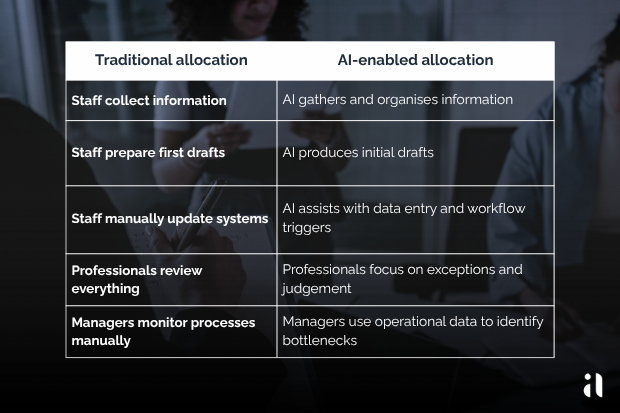
A traditional workflow might involve an administrator collecting client information, preparing documents, updating the CRM and assembling material for an adviser to review.
With AI integrated into the workflow, some of the information gathering and document preparation can be automated. The administrator’s role can consequently shift towards checking exceptions, validating information, managing client communication and ensuring the workflow reaches completion.
The adviser, meanwhile, spends less time reviewing basic administrative output and more time applying professional judgement.
The important point is that AI has not simply removed tasks. It has changed who should be responsible for the remaining work.
Redesigning Roles Around What AI Can and Cannot Do
Many job descriptions were designed around a world where one employee was responsible for completing a process from beginning to end. But when AI can now handle parts of that process, the original role description may no longer reflect where human capability creates the most value.
The answer isn’t necessarily to eliminate the position. It is to reconsider how its responsibilities are divided.
AI is particularly effective at high-volume, repetitive and structured activities such as information retrieval, document classification, data processing, first-draft generation and routine communications.
People are better positioned to handle work involving judgement, interpretation, accountability, relationships and decisions where context matters.
That creates opportunities to redesign roles around the strengths of both.
For example, a junior accountant could spend less time processing routine transactions and more time investigating exceptions, analysing financial information and supporting clients.
A customer service employee could move from answering predictable enquiries towards resolving complex cases. A marketing coordinator could spend less time producing basic content and more time interpreting campaign data, developing strategy and maintaining brand consistency.
The same principle applies in financial services. AI might gather client information, organise documents or prepare an initial summary, while support staff verify the information and manage the workflow. The adviser can then focus on interpreting the information, making professional recommendations and engaging with the client.
The key question is therefore not “Which jobs can AI replace?” but:
“Which parts of this role should AI perform, and where does human expertise create more value?”
That distinction turns AI adoption from a headcount exercise into an opportunity to redesign work itself.
Role Reassignment Can Create New Career Paths

There is another reason this shift matters: AI may change how employees progress through an organisation.
Historically, junior employees often learned by performing repetitive work.
A graduate might spend years preparing documents, processing information and completing basic analysis before gradually taking on more complex responsibilities.
If AI removes much of that foundational work, employers need to reconsider how people develop expertise.
A junior employee shouldn’t simply become the person who supervises an AI tool. They need opportunities to understand why the work is being performed, assess whether AI outputs are correct and gradually take responsibility for more complex decisions.
That could create new responsibilities around:
- AI output verification
- quality assurance
- workflow management
- data integrity
- exception handling
- process improvement
- client communication
In other words, the entry-level role itself may need to be redesigned around learning judgement rather than simply completing volume.
This could ultimately create a different career ladder, where employees move more quickly from task execution into analysis, problem-solving and decision support.
From Job Descriptions to Work Design
A job title can remain unchanged while the actual work performed within that role changes dramatically.
That means businesses need to examine their workflows before deciding whether they need to hire, replace or restructure a position.
A useful review starts with questions such as:
- What tasks does this role currently perform?
- Which of those tasks are repetitive? Which require judgement? Which could be automated?
- Which tasks could be reassigned to another team member?
- Which activities create the greatest value for the business?
This exercise can reveal something that traditional workforce planning often misses: a business may not have a headcount problem at all.
It may have a work allocation problem.
Operational Intelligence Takes AI a Step Further
Artificial intelligence is now widely discussed in terms of generative AI, automation and increasingly agentic AI. But the next opportunity for businesses is not simply getting AI to perform more tasks.
It is using AI to understand how those tasks fit together across the entire operation.
At Advice2Talent, we describe this as operational intelligence: using AI to understand how work moves through a business and identify where tasks, decisions and responsibilities should sit.
The concept is still emerging, but the underlying idea is straightforward. Instead of asking only “What can AI do?”, businesses can ask:
- Where are workflows getting stuck?
- Which tasks can be automated?
- Where is human judgement actually required?
- Which responsibilities could be reassigned?
- Where are employees losing time to unnecessary administration?
That moves AI from an individual productivity tool towards a way of redesigning the operation itself.
The Hidden Cost of Keeping Work in the Wrong Place
One of the biggest opportunities created by AI is not necessarily reducing headcount. It is making inefficient work allocation easier to identify.
Consider a financial adviser who spends several hours each week chasing documents, updating CRM records and preparing routine client materials.
Those tasks still need to happen. But if AI can reduce the amount of manual work involved, and support staff can manage the remaining operational steps, the adviser can redirect that time towards activities that require professional expertise.
The same principle applies to mortgage brokers, accountants, practice managers and other professionals.
An experienced mortgage broker may be better used writing loans and developing referral relationships than repeatedly checking application information. A senior accountant creates more value interpreting financial results than formatting routine reports.
The cost of poor work allocation is therefore larger than the salary attached to those hours.
It is the value of what could have been done instead.
AI makes it possible to identify more of these opportunities because businesses can begin analysing workflows at a level of detail that was previously difficult to achieve manually.
This does not mean every task should be automated. Jobs and Skills Australia research indicates that generative AI is generally more likely to augment occupations than completely replace them, although the impact varies between occupations and industries. The opportunity is therefore to identify where technology can increase human capacity rather than treating automation as an all-or-nothing decision.
Applying Operational Intelligence to Financial Advice
This is the thinking behind EVA, Advice2Talent’s AI designed around operational intelligence for financial advice businesses.
Rather than viewing AI as another standalone productivity tool, EVA is intended to help businesses look at how work is actually moving through their operations.
This is particularly relevant to financial advice firms, where advisers and senior professionals can spend substantial amounts of time surrounded by administrative processes.
The objective is not simply to remove the people performing that work.
It is to help businesses understand which work should be automated, which should be reassigned to support, and which genuinely requires an adviser or other experienced professional.
That creates a more deliberate workforce structure:
AI handles what it can. Support teams manage execution. Professionals focus on judgement and relationships.
The result is a workforce designed around capability rather than simply around traditional job descriptions.
Insight
For financial advice businesses, however, efficiency cannot come at the expense of governance. ASIC has specifically highlighted both the efficiency potential of AI in financial services and the risks around inaccurate information, bias, consumer vulnerability and inadequate oversight. Its reviews have also found that AI governance arrangements are not yet consistently mature across the licensees examined.
What Employers Should Do Before Reassigning Roles
AI adoption does not automatically produce better organisational design. Businesses can easily automate one process while creating another bottleneck somewhere else.
Before changing a position, employers should map the complete workflow rather than looking at individual tasks in isolation.
For example, automating document preparation may save time for an administrator but create additional review work for an adviser. Automating customer enquiries may reduce call volumes but increase the number of complex cases reaching senior staff.
What happens to the work after AI takes over part of the process?
A practical role-reassignment review should consider:
- Map the current workflow. Identify every major step from beginning to end.
- Separate tasks from decisions. Determine which activities require judgement and which are procedural.
- Identify automation opportunities. Look for repetitive, rules-based and high-volume activities.
- Redesign responsibilities. Decide who should own the remaining work once automation is introduced.
- Build quality controls. Establish who checks AI outputs and handles exceptions.
- Measure the result. Track turnaround times, errors, capacity and employee workload to determine whether the redesign actually improved the operation.
This approach prevents AI from becoming an isolated technology project. Instead, it becomes part of a broader workforce strategy.
Insight
For financial advice businesses, however, efficiency cannot come at the expense of governance. ASIC has specifically highlighted both the efficiency potential of AI in financial services and the risks around inaccurate information, bias, consumer vulnerability and inadequate oversight. Its reviews have also found that AI governance arrangements are not yet consistently mature across the licensees examined.
The Future of Work May Be About Who Does What
AI isn’t simply changing which tasks get done. It’s changing who should do them.
As businesses rethink how work is divided between AI, support teams and professionals, the opportunity is to build leaner, more capable teams without automatically adding more headcount.
At Advice2Talent, we help Australian businesses combine AI, offshore talent and onshore expertise to build smarter, more efficient workforce structures.
Talk to our team about how you can redesign roles and create more capacity with EVA and the right talent.
Articles You Might Also Like

AI in the Workplace: How Businesses are Redesigning Jobs and Roles
AI isn’t simply replacing jobs. It’s changing who does what. Discover how Australian businesses are redesigning roles, reallocating responsibilities and combining AI with human expertise to build more capable, efficient teams.

Experience vs Expertise: Which Matters More When Hiring?
Years of experience can tell you where a candidate has been, but expertise tells you what they can do. Learn how to assess both when hiring the right candidate.

Where the Biggest Opportunities are in Wealth Management
Australia’s wealth management opportunity is growing – but so is the challenge of serving it. Explore where the biggest opportunities lie, from retirement advice and adviser capacity to technology and smarter workforce models.

Operational Intelligence: The New Competitive Advantage for Growing Businesses
AI can automate tasks, but Operational Intelligence transforms entire workflows. Discover how businesses are combining AI, people, and smarter processes to unlock capacity, improve efficiency, and gain a lasting competitive advantage.

How AI Will Impact Entry-Level Jobs in Australia
AI isn’t eliminating entry-level jobs—but it is changing how careers begin. Learn how AI is reshaping graduate roles in Australia, the skills employers now value most, and why human judgement is becoming more important than ever.

Why Your Best Employees May Be Burning Out Mid-Year
Burnout isn’t always obvious. Learn why your highest-performing employees are often the most at risk, the warning signs managers miss, and how better workload design can help prevent burnout before it impacts retention and performance.