

What Payday Super Means for Financial Advisers and Business Owners

From 1 July 2026, one of the biggest payroll compliance changes in years is coming into effect for Australian employers.

Under the new Payday Super rules, businesses will be required to pay employees’ super guarantee at the same time as salary and wages, rather than quarterly.

For many businesses, particularly financial planning firms, mortgage brokers, accounting practices, and SMEs, this is more than just an administrative update. 

It changes payroll timing, cash flow management, reporting obligations, and the operational processes sitting behind every pay run.

While the legislation is designed to improve retirement outcomes for employees and reduce unpaid super, it will also place additional pressure on businesses that still rely heavily on manual payroll workflows or delayed super processing.

What is Payday Super

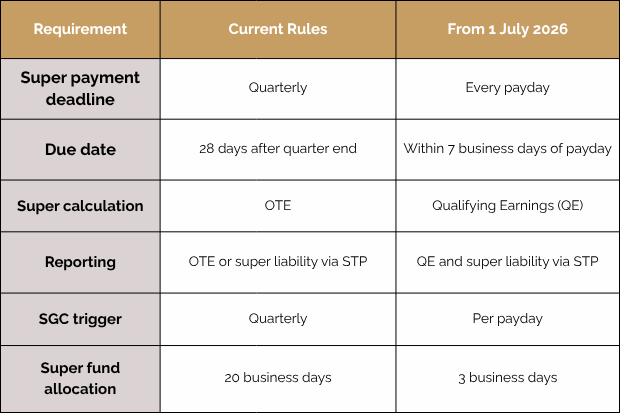
Table of differences between current and new Payday Super law.
The move from quarterly super payments to payday-based contributions represents one of the biggest payroll compliance changes in recent years.

Under the current system, employers can pay super quarterly as long as contributions are received by the employee’s super fund by the quarterly due dates.

From 1 July 2026, that changes. Employers will need to:

  • Pay super at the same time as salary and wages
  • Ensure contributions are received by the employee’s super fund within 7 business days of payday
  • Report both qualifying earnings (QE) and super liability through Single Touch Payroll (STP)


The new rules also expand how super is calculated.

Instead of using ordinary time earnings (OTE), super guarantee will now be calculated on qualifying earnings (QE), which includes additional payment types such as salary sacrifice contributions and other amounts currently included in salary and wages calculations.

Insight

Under Payday Super, super contributions must be received by an employee’s super fund within 7 business days of payday – a major shift from the current quarterly system many businesses still rely on.

Why Payday Super Matters for Financial Advisers

Broker highlighting the important contract terms.
Financial advisers, brokers, and professional services firms may need stronger payroll and compliance processes to meet the new requirements.

For financial advice firms, mortgage brokers, and professional services businesses, payroll compliance is already closely tied to operational efficiency.

Many smaller firms operate with lean internal teams, meaning payroll, administration, compliance, and workflow management are often handled by only a few people.

That creates risk when regulations become more time-sensitive.

Under Payday Super, businesses will have less flexibility around payment timing and fewer opportunities to correct payroll issues before penalties apply. 

Even small delays caused by incorrect employee details, manual processing errors, or cash flow bottlenecks may create compliance problems much faster than under the current quarterly framework.

This is particularly relevant for:

  • Financial planning firms with growing support teams
  • Mortgage brokerages scaling operations
  • Accounting firms managing multiple payroll cycles
  • SMEs relying on manual payroll processes
  • Businesses using offshore or remote support staff through payroll structures or EOR arrangements


For firms already balancing client work, compliance, and staffing pressures, Payday Super adds another layer of operational discipline.

The Biggest Risks Businesses Need to Prepare For

One reason many businesses are paying close attention to Payday Super is the impact on working capital. 

Under the current system, employers can retain super contributions until quarterly due dates. 

From July 2026, that buffer largely disappears because super must be paid alongside each payroll cycle.

Modelling from Employment Hero, based on more than 300,000 businesses, estimated an average working capital shift of approximately $124,000 as employers move to more frequent super payments. 

While the impact will vary depending on payroll size, many businesses will need to rethink how they manage cash flow throughout the year.

Insight

Many businesses currently benefit from holding up to two or three months’ worth of super contributions before quarterly payment deadlines. Payday Super effectively removes that cash-flow buffer.

Payroll Errors Become More Serious

Under the new framework, payroll mistakes can escalate much faster.

Incorrect employee super details, delayed processing, or payment failures may result in super contributions missing the new 7-business-day deadline.

Because reporting will also become more real-time through STP, businesses will have less room to identify and fix issues retrospectively.

Penalties and Super Guarantee Charges Increase

The updated Super Guarantee Charge (SGC) framework will also become stricter.

From July 2026:

  • The ATO will assess the SGC directly
  • Interest will compound daily
  • Administrative uplifts may apply depending on compliance history
  • Penalties of 25% or 50% of unpaid SGC may apply


While the new SGC will become tax deductible, the overall compliance exposure for late payments increases substantially.

The government has positioned Payday Super partly as a response to unpaid super across the Australian workforce. According to ATO estimates, employees were owed approximately $3.4 billion in unpaid super during the 2019–20 financial year.

The new framework is designed to identify missed contributions earlier and reduce the likelihood of unpaid super accumulating over long periods.

Insight

Under Payday Super, late contributions will be assessed on a payday-by-payday basis rather than quarterly. Interest will compound daily, and administrative uplifts of up to 60% may apply in some circumstances.

Why Operational Efficiency Will Matter More

The financial advice industry is already seeing this shift happen in real time.

AI tools are increasingly being used to assist with:

  • Statement of Advice drafting
  • File note generation
  • Meeting summaries
  • Research collation
  • CRM updates and workflow management
  • Compliance documentation


Platforms like Marloo are part of a growing wave of AI tools designed specifically for advice practices, helping automate sections of the advice preparation and documentation process.

Tasks that once required hours of administrative or paraplanning support can now be partially automated in minutes.

This has naturally created anxiety across operational and support roles within financial planning firms, particularly among paraplanners and administrative staff.

However, most advice businesses are not removing humans from the process entirely. Financial advice remains heavily regulated, and AI-generated outputs still require review, interpretation, compliance oversight, and adviser accountability.

In practice, many firms are using AI to speed up preparation work rather than replace experienced support staff altogether. 

The role itself may evolve, but human judgment still plays a critical role in ensuring advice quality, accuracy, and compliance.

Insight

Super funds currently have up to 20 business days to allocate contributions. Under Payday Super, that timeframe drops to just 3 business days, supporting faster contribution processing and error detection.

How Payday Super Could Affect Offshore and Remote Teams

For businesses using offshore staff or Employer of Record (EOR) structures, Payday Super may also increase the importance of having clean payroll coordination and accurate worker classification.

As businesses scale remote and distributed teams, payroll obligations become more operationally complex. That includes:

  • Managing multiple pay cycles
  • Coordinating payroll providers
  • Maintaining accurate employee records
  • Ensuring super obligations are processed correctly and on time


For many firms, this may accelerate investment into payroll automation, workflow documentation, and dedicated operational support staff.

The goal is not simply processing payroll faster. It is reducing the risk of compliance issues before they happen.

Articles You Might Also Like​

Virtual Assistants and Remote Work
Carolina Castillo

Why Your Best Employees May Be Burning Out Mid-Year

Burnout isn’t always obvious. Learn why your highest-performing employees are often the most at risk, the warning signs managers miss, and how better workload design can help prevent burnout before it impacts retention and performance.

Read More »
Business Growth and Strategy
Carolina Castillo

Are Your Labour Costs Driving Profit or Inefficiency This EOFY?

Most EOFY conversations focus on tax deductions and refunds. But what if the bigger profitability issue is hiding in your labour costs? Learn how rising employment expenses, administrative bottlenecks, and inefficient team structures may be costing your business more than you realise.

Read More »
Virtual Assistants and Remote Work
Carolina Castillo

How to Build Team Culture With Offshore and Remote Teams

Building a strong culture with offshore and remote teams takes more than workflows and productivity metrics. From team outings and company events to recognition and connection, discover how businesses can improve engagement, retention, and performance by creating a workplace people genuinely want to be part of.

Read More »

One Response

Leave a Reply

Your email address will not be published. Required fields are marked *