


Australia’s wealth management industry is sitting on an enormous pool of capital.
As at March 2026, Australia’s superannuation system held approximately $4.44 trillion in assets, up 7.9% from the previous year. Contributions reached $226.1 billion over the year, while benefit payments rose to $143.5 billion.
Those numbers tell only part of the story.
Behind them is a population approaching retirement, increasingly complex financial decisions, changing expectations around financial advice, and a shortage of professionals available to serve the growing need.
For wealth management businesses, that creates an unusual situation: the opportunity isn’t necessarily finding more wealth to manage. It’s finding better ways to serve the wealth already sitting within the Australian system.
Australia's Wealth Pool is Growing More Complex
Australia’s superannuation system has become one of the largest pools of retirement capital in the world. Total superannuation assets reached $4.44 trillion in March 2026, while member assets alone accounted for $2.79 trillion across 23.6 million member accounts.
But asset growth is only one part of the opportunity. As Australians move from accumulation into retirement, financial decisions become considerably more complicated. Clients are no longer simply asking how much they should contribute to super or which investment option they should select.
They may need to consider retirement income, tax, investment strategy, estate planning, aged care, Centrelink, insurance, property, and intergenerational wealth transfer – often at the same time.
The result is a wealth management market where complexity itself is creating demand for advice. That is particularly significant because the industry does not have an unlimited supply of advisers to meet it.
The Advice Gap Creates a Capacity Problem
Australia’s demand for financial advice is growing at a time when the profession is dealing with a shortage of advisers.
The Financial Services Council has highlighted the sharp decline in new entrants to the profession, with the number falling from almost 5,000 in 2018 to just over 550 in 2025.
At the same time, the FSC estimates that more than 2.5 million Australians are expected to retire over the next decade, while CoreData estimates around 1.7 million Australians who want financial advice may be unable to access it.
For an advice practice, adding more clients isn’t particularly useful if every additional client requires a proportional increase in adviser time. At some point, the traditional model reaches a ceiling: advisers can only hold so many meetings, prepare so many strategies, review so many files, and respond to so many client requests.
That makes operational scalability one of the biggest opportunities in wealth management.
Insight
Australia’s wealth management opportunity is increasingly a capacity challenge. The firms best positioned for growth will be those that can serve more clients without requiring every additional client to consume another equivalent amount of adviser time.
Retirement Advice is Becoming a Major Growth Opportunity
One of the clearest opportunities sits around retirement. As more Australians approach retirement, the nature of financial advice changes. Accumulation is relatively straightforward compared with the decisions that arise once clients begin drawing on their wealth.
How much can a client sustainably spend? When should they access super? How should assets be structured? What happens if markets fall early in retirement? How should investment income interact with other sources of retirement income?
These are high-consequence decisions where professional judgement matters.
The scale of the opportunity is reflected in recent industry research. The FSC’s 2026 research into digital advice found that among Australians aged 55–59, those already using digital financial tools were more than three times as likely to say they would seek financial advice within the next 12 months compared with non-users – 44% versus 13%.
Digital engagement isn’t necessarily replacing advisers. It may actually be creating a larger pipeline of people who are eventually ready to engage with one.
That points towards a more integrated wealth management model, where digital tools help clients become informed and advisers provide the judgement required for more complex decisions.
The Opportunity is More Adviser Capacity
This is where the economics of wealth management become particularly interesting.
An adviser’s time is finite, but not every activity performed within an advice practice requires an adviser’s expertise.
Research and preparation, document collection, CRM administration, appointment coordination, file management, implementation support, reporting and follow-up can all consume significant amounts of time without requiring the adviser to make the final professional judgement.
When those activities accumulate, the practice effectively has an expensive bottleneck.
The adviser becomes responsible for both the work that creates value and the work that enables that value to be delivered.
This creates an opportunity to redesign the operating model.
Instead of asking an adviser to own an entire workflow, firms can separate the workflow into distinct components and assign each to the most appropriate resource.
An adviser can focus on strategy and client relationships. A paraplanner can support technical preparation. A client service officer can manage administration and client communication. Technology can automate repetitive steps. Offshore support can provide additional operational capacity where appropriate.
The opportunity is not simply to reduce costs. It is to increase the amount of high-value work each adviser can deliver.
Technology is Opening Another Layer of Opportunity

Technology is also changing how wealth management businesses think about scale.
The rise of generative AI and increasingly capable AI systems means many activities that previously required manual processing can now be assisted or automated.
But the greatest opportunity isn’t necessarily replacing individual tasks. It is connecting technology to the broader workflow.
For example, an AI system might identify information from a client document. A workflow could then route that information to the appropriate team member, trigger a follow-up task, update a system, or flag an exception for human review.
That is fundamentally different from simply giving an adviser another AI writing tool.
The technology becomes part of the operating model rather than another application sitting alongside it.
This is particularly relevant as advice practices look for ways to improve productivity without compromising quality, compliance, or client experience.
Wealth Management is Becoming More Hybrid
The traditional distinction between “human advice” and “digital advice” is also becoming less useful.
Recent FSC research found strong support for hybrid models combining digital tools with human judgement. Among digital advice users aged 55–59, 53% preferred a combination of human and digital advice, while 48% of users aged 60 and above expressed the same preference.
The research also found that trust in AI-enabled advice increases when human oversight is explicitly part of the model.
That suggests the future of wealth management may not be about choosing between technology and advisers. It is about deciding where each is most useful.
Technology can make information easier to access, accelerate preparation, and remove friction from administrative processes.
Advisers remain responsible for understanding the client’s circumstances, applying professional judgement, navigating complexity, and helping clients make decisions with significant financial consequences.
The firms that combine those capabilities effectively may have a significant advantage.
The Biggest Opportunity May Be Inside the Practice

There is another opportunity that is easy to overlook: improving the economics of the existing client base.
A practice does not necessarily need thousands of new clients to grow. It may be able to create more capacity by changing how existing clients are serviced.
Consider a practice where advisers spend several hours each week on administrative work. Reassigning some of that workload could create additional adviser capacity without adding another adviser immediately.
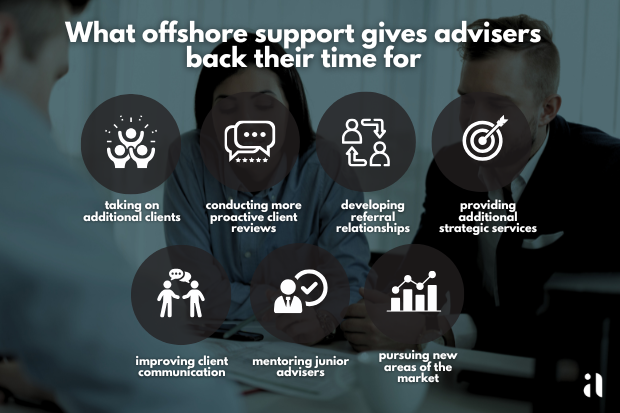
That capacity could then be used for:
- taking on additional clients
- conducting more proactive client reviews
- developing referral relationships
- providing additional strategic services
- improving client communication
- mentoring junior advisers
- pursuing new areas of the market
The commercial value comes from what the practice can do with the capacity it creates.
This is why workforce design is becoming increasingly important in wealth management. The question isn’t simply how many people a practice employs, but how much productive capacity each role creates for the wider business.
The Next Growth Phase Will Depend on How Firms Scale
Australia’s wealth management opportunity is clear: more retirement assets, more complex financial decisions, growing demand for advice, and a limited supply of advisers.
The difficult part is turning that demand into sustainable growth.
Firms that continue to rely on advisers to manage every stage of the client journey may eventually find growth constrained by capacity.
Firms that redesign their operating models can create a different equation—using advisers where professional judgement matters most, support teams where execution is required, and technology where automation makes sense.
At Advice2Talent, we help Australian financial advice and wealth management businesses build the operational capacity to grow through a combination of skilled talent, offshore support and technology-enabled workflows.
Articles You Might Also Like

Where the Biggest Opportunities are in Wealth Management
Australia’s wealth management opportunity is growing – but so is the challenge of serving it. Explore where the biggest opportunities lie, from retirement advice and adviser capacity to technology and smarter workforce models.

Operational Intelligence: The New Competitive Advantage for Growing Businesses
AI can automate tasks, but Operational Intelligence transforms entire workflows. Discover how businesses are combining AI, people, and smarter processes to unlock capacity, improve efficiency, and gain a lasting competitive advantage.

How AI Will Impact Entry-Level Jobs in Australia
AI isn’t eliminating entry-level jobs—but it is changing how careers begin. Learn how AI is reshaping graduate roles in Australia, the skills employers now value most, and why human judgement is becoming more important than ever.

Why Your Best Employees May Be Burning Out Mid-Year
Burnout isn’t always obvious. Learn why your highest-performing employees are often the most at risk, the warning signs managers miss, and how better workload design can help prevent burnout before it impacts retention and performance.

Should You Change Jobs or Stay Put? Understanding Job Hopping vs Job Hugging
Should you stay with your current employer or look for a new opportunity? This guide explores the differences between job hopping and job hugging, helping professionals make informed career decisions while giving employers valuable insights into employee retention.

Are Your Labour Costs Driving Profit or Inefficiency This EOFY?
Most EOFY conversations focus on tax deductions and refunds. But what if the bigger profitability issue is hiding in your labour costs? Learn how rising employment expenses, administrative bottlenecks, and inefficient team structures may be costing your business more than you realise.