


Should You Change Jobs or Stay Put? Understanding Job Hopping vs Job Hugging

For years, career advice followed a fairly predictable formula: find a good employer, work hard, stay loyal, and your career will naturally progress.

Today’s workforce looks very different.

Some professionals move between employers every few years in pursuit of higher salaries, better opportunities, and faster career progression. Others remain with the same organisation for years, valuing stability, familiarity, and long-term relationships.

These two approaches have become known as job hopping and job hugging.

Neither is inherently right or wrong. In fact, both have become more common as economic conditions, workplace expectations, and career priorities continue to evolve.

For professionals, the question isn’t simply whether you should leave or stay. It’s whether your current role is still moving your career forward.

For employers, it’s understanding why talented people leave a job – and why others stay even when they’ve become disengaged.

How Today's Labour Market is Changing Career Decisions

Open laptop on the desk, job search title on screen.
Today's workforce is balancing opportunity with uncertainty, making career decisions more complex than simply chasing a higher salary.

The employment market has changed significantly over the past few years.

In Australia, businesses continue to face skills shortages across many professional industries, yet employees have become increasingly cautious about changing jobs amid rising living costs, higher interest rates, economic uncertainty, and rapid technological change.

Recent LinkedIn workforce research found that only 51% of Australian professionals plan to look for a new job in 2026, down from 59% in 2025. 

Meanwhile, Jobs and Skills Australia reports that labour mobility has eased back to levels more consistent with the 2010s, reflecting a growing preference for stability despite ongoing demand for skilled workers.

In contrast, the Philippines continues to experience much stronger job-change intentions. Recent talent market research found that 54% of Filipino professionals are considering changing jobs within the next 12 months, while 66% say they would still leave even if their employer made a counteroffer.

Although the reasons differ, professionals in both countries are asking the same question:

“Should I stay where I am, or is it time to move on?”

Insight

Australia and the Philippines are moving in opposite directions. Australian workers are becoming more cautious about changing employers, while more than half of Filipino professionals still intend to move within the next year. In both markets, however, the decision is increasingly driven by career development rather than loyalty alone.

What is Job Hopping?

Job hopping generally refers to changing employers every two to four years, sometimes sooner.

Years ago, this could raise concerns with employers. Today, attitudes have changed.

Strategic career moves are often viewed positively because they expose professionals to different industries, technologies, leadership styles, and ways of working.

For professionals in financial planning, mortgage broking, and accounting, changing firms may provide opportunities to:

  • broaden technical expertise
  • work with different client segments
  • gain exposure to new software and systems
  • move into leadership roles
  • increase earning potential
  • expand professional networks


Many salary increases also occur when changing employers rather than remaining in the same organisation.

This partly explains why job hopping remains common in markets like the Philippines. Despite ongoing economic uncertainty, more than half of professionals are still actively considering new opportunities, suggesting that career progression and better compensation continue to outweigh the perceived security of staying put.

However, frequency alone doesn’t determine whether job hopping is beneficial. Employers increasingly look for progression.

Does each move represent greater responsibility?

Have new skills been developed?

Has the candidate continued growing?

If every move tells a logical career story, changing employers is rarely viewed negatively.

What is Job Hugging?

Job hugging is the opposite. Rather than changing employers regularly, job huggers remain in the same organisation even when they’ve mentally outgrown the role.

Sometimes this reflects genuine satisfaction. Other times, it’s driven by uncertainty.

Australia is currently seeing more of this behaviour. With economic uncertainty and cost-of-living pressures remaining high, many professionals are delaying career moves even when they feel ready for a new challenge. Stability has become increasingly valuable, but that doesn’t always mean it’s the best long-term career decision.

People stay because they:

  • value stability
  • have financial commitments
  • enjoy their colleagues
  • worry about economic conditions
  • fear starting somewhere new
  • believe things will eventually improve


None of these reasons are necessarily wrong. The danger comes when familiarity becomes the primary reason for staying.

Psychologists often refer to this as status quo bias—our tendency to prefer familiar situations, even when change could produce better outcomes.

The longer someone remains in the same role without continued development, the easier it becomes to confuse comfort with career progression.

Insight

Staying with one employer isn’t the same as standing still. The real question is whether your responsibilities, skills, and opportunities continue growing alongside your years of service.

When Changing Jobs Makes Sense

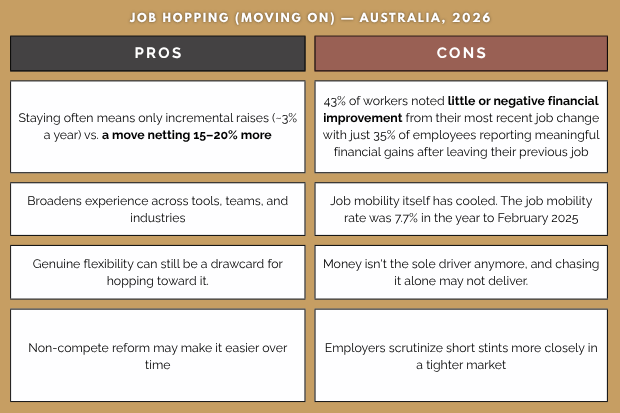
Pros and cons table of job hopping
Job hopping can accelerate career growth when each move builds new skills, responsibilities, and opportunities.

Changing employers can be one of the most effective ways to accelerate your career – but only when there’s a clear reason behind the move.

It may be time to consider new opportunities if:

  • your salary has fallen behind current market rates
  • career progression has stalled
  • learning opportunities have disappeared
  • leadership or workplace culture has deteriorated
  • workload has become unsustainable
  • your responsibilities continue growing without recognition or compensation


This is particularly relevant in industries like financial planning and mortgage broking, where evolving regulations, technology, and client expectations create continuous opportunities for professional development.

The best career moves aren’t simply about earning more. They’re about positioning yourself for greater responsibility and long-term growth.

When Staying is Actually the Better Choice

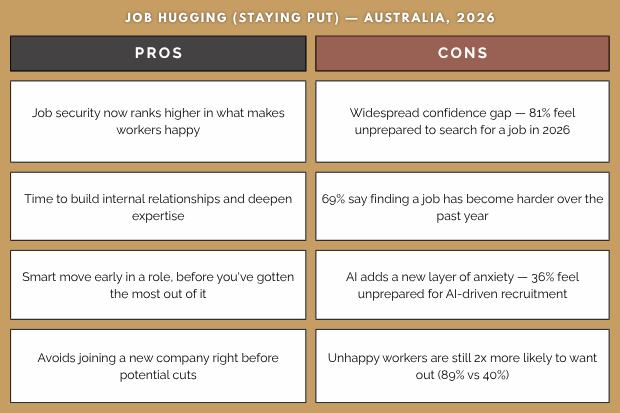
Pros and cons table of job hugging
Long tenure becomes a strength when it comes with continuous development, meaningful progression, and competitive remuneration.

Changing jobs isn’t always the smartest decision. Some of the most successful professionals spend many years with the same employer. The difference is that they continue growing while they stay.

Long tenure becomes a competitive advantage when:

  • responsibilities continue expanding
  • remuneration remains competitive
  • leadership invests in development
  • new challenges continue emerging
  • there is genuine career progression


Financial advisers, accountants, and mortgage brokers often build trust with clients over many years. Remaining with one firm can strengthen those relationships while creating opportunities for referrals and leadership positions that wouldn’t exist elsewhere.

Career longevity isn’t a weakness. Remaining in the same role without continued growth is.

Can Job Hugging Hurt Your Career?

Tired drained entrepreneur sleeping on desk in startup office.
Staying in the same role isn't the problem. Staying without learning, growing, or feeling challenged is where careers can begin to stagnate.

Job hugging isn’t necessarily a bad thing. Many professionals build rewarding careers with the same employer over many years. The risk arises when staying becomes automatic rather than intentional.

Professionals who remain in the same role without regularly benchmarking themselves against the broader market may not realise how much their industry has evolved. 

Technology advances, new specialisations emerge, salary benchmarks shift, and leadership opportunities open elsewhere. 

Over time, it’s easy to assume your career is progressing simply because you’ve gained more years of experience, when in reality, career growth should be measured by the skills you’ve developed, the responsibilities you’ve taken on, and the value you bring to the market.

This is why periodically assessing your career is important, even if you have no immediate plans to leave. Speaking with recruiters, reviewing salary guides, attending industry events, or simply understanding current hiring trends can provide valuable perspective. 

Gathering information doesn’t commit you to changing jobs – it helps you make more informed decisions about your future.

Economic uncertainty can also influence these decisions. With rising living costs and a less predictable employment market, many professionals choose to stay where they are because stability feels like the safer option. 

That can be a sensible choice, provided it’s based on genuine career satisfaction rather than fear of change.

Sometimes, the most valuable outcome of exploring the market isn’t finding a higher-paying role. 

It’s confirming that your current employer continues to offer strong opportunities – or recognising that your skills and experience have become more valuable than you realised.

What Employers Should Learn

Most businesses pay close attention to turnover rates. If employees are leaving frequently, it’s usually treated as a warning sign. But the opposite isn’t always true. Low turnover doesn’t automatically mean your organisation is healthy.

Job hopping and job hugging can both reveal valuable insights about your workforce – they just tell different stories.

High turnover may point to issues with remuneration, career progression, leadership, workload, or workplace culture. It can also reflect a competitive labour market where skilled professionals have more opportunities available to them.

On the other hand, a workforce with very low turnover isn’t necessarily more engaged. 

Employees may be staying because they value the culture and see a future with the business, but they may also be staying because economic uncertainty has made changing jobs feel too risky. 

Those are two very different forms of retention, and they require different management approaches. 

As more professionals choose stability over change, employers should look beyond tenure and consider broader indicators such as employee engagement, internal promotions, learning participation, performance, and regular feedback.

Ultimately, the goal isn’t simply to keep employees for as long as possible. When employees stay because they’re growing – not because they’re hesitant to leave – retention becomes a meaningful measure of organisational success rather than just another HR metric.

Insight

Some 2025–2026 reporting based on Aon studies suggests the Philippines could see around 20% attrition in certain turnover projections. However, a low turnover rate does not always mean a healthy workplace, just as frequent job changes do not automatically signal disloyalty.

Before You Decide to Stay or Leave

Whether you’re considering a new opportunity or planning to stay where you are, ask yourself:

  • Am I still learning?
  • Has my salary kept pace with the market?
  • Do I feel challenged in a positive way?
  • Is there a realistic pathway for growth?
  • Would I choose this job again if I were applying today?


If several of those answers are no, it may be worth exploring what’s available. If they’re yes, staying could be the smartest career move you make!

The important thing is that the decision is intentional, not simply the result of habit or uncertainty.

Your Career Should Move Forward Wherever You Work

Job hopping isn’t automatically a sign of ambition. In the same way, job hugging isn’t automatically a sign of loyalty.

The strongest careers aren’t defined by the number of employers on your resume or the number of years spent with one company. They’re built through thoughtful decisions, continuous learning, and choosing opportunities that align with your long-term goals.

Whether you’re exploring your next move or simply curious about how your role compares to today’s market, having accurate information is invaluable.

At Advice2Talent, we work with professionals across financial planning, mortgage broking, and accounting to benchmark salaries, understand market trends, and navigate career decisions with confidence. 

Sometimes the best career move is staying exactly where you are. Other times, it’s discovering an opportunity you didn’t know existed. 

Articles You Might Also Like​

Business Growth and Strategy
Carolina Castillo

Are Your Labour Costs Driving Profit or Inefficiency This EOFY?

Most EOFY conversations focus on tax deductions and refunds. But what if the bigger profitability issue is hiding in your labour costs? Learn how rising employment expenses, administrative bottlenecks, and inefficient team structures may be costing your business more than you realise.

Read More »
Virtual Assistants and Remote Work
Carolina Castillo

How to Build Team Culture With Offshore and Remote Teams

Building a strong culture with offshore and remote teams takes more than workflows and productivity metrics. From team outings and company events to recognition and connection, discover how businesses can improve engagement, retention, and performance by creating a workplace people genuinely want to be part of.

Read More »

Leave a Reply

Your email address will not be published. Required fields are marked *