

What to Expect When You Resign After Accepting a New Job Offer

A few years ago, artificial intelligence still felt experimental for most people.

Now, tools like Anthropic’s Claude, OpenAI’s ChatGPT, and other generative AI systems are writing emails, analysing documents, answering customer questions, generating code, and completing tasks that once required human workers. 

That shift has made AI feel far more personal and immediate.

The conversation is no longer just about technology. It is about careers, job security, and whether entire industries are about to change faster than workers can adapt. Questions like 

“Will AI take our jobs?”, “What jobs will disappear by 2030?”, and “Which skills are still safe?” are becoming increasingly common across both professional and everyday conversations.

The short answer is this: AI is already changing work. But the reality is far more nuanced than “robots replacing humans.”

Why AI Anxiety Suddenly Feels Real

AI startup intern holding laptop asks questions to senior technician.
Generative AI and AI agents are transforming workflows by automating repetitive and process-driven tasks.

For years, automation mainly affected repetitive physical labour or manufacturing work. 

Generative AI changed that conversation because it began affecting white-collar and knowledge-based jobs instead.

Today, AI can:

  • Draft reports and emails
  • Analyse spreadsheets and documents
  • Generate marketing copy
  • Summarise meetings
  • Write software code
  • Handle customer support conversations
  • Process repetitive admin tasks


That’s why tools like Claude and ChatGPT created such a strong reaction. For the first time, professionals in office-based roles could directly see AI performing parts of their own work.

Generative AI vs Agentic AI

Part of the reason AI feels more disruptive today is because the technology itself is evolving quickly.

Most people are already familiar with generative AI tools like ChatGPT or Claude. These systems generate content based on prompts. 

They can write, summarise, brainstorm, analyse information, and assist with communication tasks.

Agentic AI, however, goes a step further.

Instead of simply responding to prompts, AI agents are designed to carry out workflows and actions more autonomously. 

They can interact with software, retrieve information, follow processes, and complete multi-step operational tasks with minimal human input. This is where much of the current workplace anxiety is coming from.

Businesses are no longer just experimenting with AI-generated content. They are increasingly exploring AI systems that can function more like digital workers inside existing operations. 

In industries like financial advice, accounting, and mortgage broking, this is already beginning to reshape how administrative, operational, and support work gets done.

At the same time, most firms are not replacing human teams entirely. Instead, they are combining AI systems with skilled operational staff to improve efficiency and scalability. 

AI agents like Advice2Talent’s EVA AI are examples of how businesses are beginning to integrate AI-driven support into everyday workflows while still relying heavily on human oversight, judgment, and relationship management.

Insight

AI adoption is accelerating fastest in customer service, administration, marketing, and data-heavy operational roles – particularly where work is repetitive and rules-based.

Is AI Going to Take Over My Job?

Unemployed man desperately looking for a job holding a need a job sign.
Growing concerns around automation are raising questions about which jobs are most vulnerable to AI-driven change.

For most people, the answer is probably no – but parts of their job may change significantly.

One of the biggest misconceptions about AI is that it replaces entire roles overnight. In reality, businesses are more commonly using AI to automate specific tasks inside existing workflows.

That distinction matters.

For example:

  • An accountant may use AI to speed up reconciliations and reporting
  • A customer support team may use AI chat systems to handle basic enquiries
  • A financial advice firm may automate document preparation or meeting summaries
  • Marketing teams may use AI for first-draft content creation


In these situations, the job itself still exists. But the way the work gets done changes.

This is why many experts believe AI will reshape jobs faster than it fully replaces them.

Which Jobs are Most Vulnerable to AI

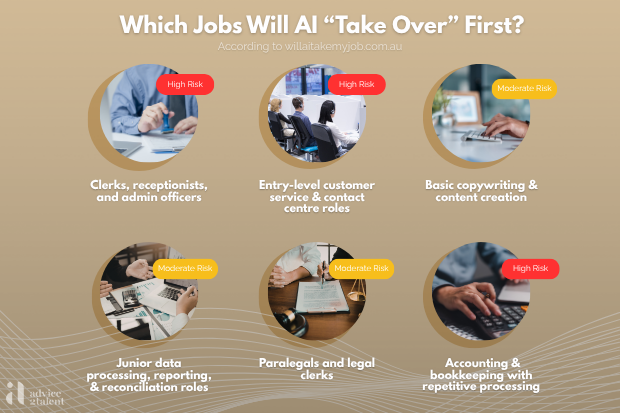
Infographic of jobs most likely affected by AI
Administrative, clerical, and repetitive digital roles are among the jobs most exposed to AI-driven automation.

The jobs most exposed to AI tend to share a common pattern: they are repetitive, text-heavy, rules-based, and rely on structured digital workflows rather than complex human judgment.

Australian labour market research consistently points to the same trend, but with an important nuance – exposure does not automatically mean job loss.

Analysis from Jobs and Skills Australia, alongside CSIRO AI workforce research and local AI exposure modelling tools, shows that only a small proportion of roles fall into high automation risk categories. 

However, a much larger share of the workforce sits in roles that are more likely to be reshaped or augmented by AI.

Based on Australian ANZSCO-aligned role mapping, the highest exposure is typically seen in areas such as:

  • Administrative and clerical support roles (including general clerks, receptionists, and admin officers)
  • Entry-level customer service and contact centre roles
  • Routine text production tasks such as basic copywriting or templated content creation
  • Junior data processing, reporting, and reconciliation roles
  • Legal and administrative support roles such as paralegals and legal clerks
  • Certain accounting and bookkeeping functions involving repetitive processing


More recent Australian workforce modelling also shows a clear divide: clerical and contact-centre roles sit at the highest end of exposure, while many professional, technical, and advisory roles fall into a “medium exposure, high augmentation potential” category. 

In other words, the work changes significantly, but it does not disappear.

This is consistent with findings from CSIRO analysis of Australian employers, which shows that organisations adopting AI tend to expand hiring in knowledge-intensive roles while simultaneously shifting the tasks within those roles. 

Rather than eliminating accountants, analysts, or advisers, AI is increasingly changing what those roles spend their time doing.

How AI is Affecting Financial Advice and Paraplanning

The financial advice industry is already seeing this shift happen in real time.

AI tools are increasingly being used to assist with:

  • Statement of Advice drafting
  • File note generation
  • Meeting summaries
  • Research collation
  • CRM updates and workflow management
  • Compliance documentation


Platforms like Marloo are part of a growing wave of AI tools designed specifically for advice practices, helping automate sections of the advice preparation and documentation process.

Tasks that once required hours of administrative or paraplanning support can now be partially automated in minutes.

This has naturally created anxiety across operational and support roles within financial planning firms, particularly among paraplanners and administrative staff.

However, most advice businesses are not removing humans from the process entirely. Financial advice remains heavily regulated, and AI-generated outputs still require review, interpretation, compliance oversight, and adviser accountability.

In practice, many firms are using AI to speed up preparation work rather than replace experienced support staff altogether. 

The role itself may evolve, but human judgment still plays a critical role in ensuring advice quality, accuracy, and compliance.

Insight: Many companies are not replacing workers overnight. Instead, AI is reducing the need for additional hiring by allowing smaller teams to handle larger workloads.

Who is Already Being Affected by AI?

The impact of AI is already visible across several industries, particularly in administrative and digital work.

Early-career professionals appear to be among the most affected groups so far. Studies have shown that junior employees in highly AI-exposed roles are experiencing reduced hiring demand as businesses automate lower-level tasks.

There are also concerns that women may be disproportionately affected because they are heavily represented in administrative, clerical, and coordination roles that face higher automation risk.

At the same time, many companies are discovering that removing humans entirely creates its own problems.

Research from Harvard Business Review suggests that businesses often see better results when AI supports employees rather than replaces them completely. Human oversight, communication, and decision-making still play a major role in successful operations.

Why Human Workers Still Matter

Despite rapid improvements, AI still struggles in areas requiring:

  • Judgment and decision-making
  • Relationship management
  • Emotional intelligence
  • Strategic thinking
  • Leadership and negotiation
  • Complex problem-solving
  • Compliance oversight and accountability


This is especially important in industries like financial advice, mortgage broking, accounting, healthcare, and professional services, where trust and human interpretation remain critical.

AI can generate information quickly. But humans still decide what to do with it. That distinction is likely to remain important for years to come.

Insight

Companies investing in AI augmentation – where humans and AI work together – often report stronger long-term productivity gains than businesses focused purely on reducing headcount.

What Skills are Most AI-Proof

No role is completely immune to technological change. However, certain skills are becoming more valuable precisely because AI struggles to replicate them.

Workers who are likely to remain resilient are those who can:

  • Communicate clearly with clients and teams
  • Think strategically rather than just execute tasks
  • Solve ambiguous or complex problems
  • Build relationships and trust
  • Manage people and workflows
  • Interpret information rather than simply process it
  • Use AI tools effectively instead of avoiding them


AI literacy itself is also becoming increasingly important.

The professionals who adapt fastest may not be the ones competing against AI, but the ones learning how to work alongside it.

How Businesses are Combining AI and Human Teams

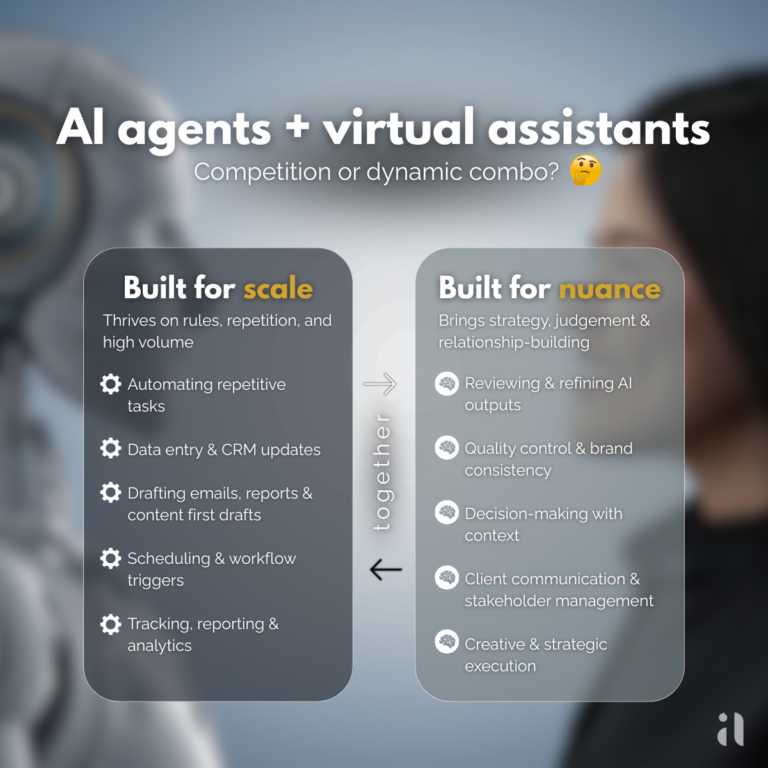
Comparison table of AI agents and virtual assistants purpose
Many businesses are adopting hybrid workforce models where AI systems and human teams work alongside each other.

Most businesses are not moving toward fully AI-driven workplaces.

Instead, many are building hybrid workforce models where:

  • AI handles repetitive and administrative tasks
  • Offshore or support teams manage operational workflows
  • Senior staff focus on strategy, relationships, and decision-making

This model is becoming increasingly common because AI works best when paired with human oversight.

For example, AI might prepare reports, summarise meetings, or organise data – while human workers review outputs, manage clients, and make final decisions.

This is one reason offshore support teams are unlikely to disappear entirely. In many businesses, AI is actually making human teams more productive rather than making them obsolete.

Stay Valuable in an AI-Driven Workplace

The workers most at risk are not necessarily those with the “wrong” jobs. More often, the bigger risk is staying static while technology changes around you.

The safest long-term approach is to understand how AI is affecting your industry, learn how to use these tools effectively, and focus on skills that still rely heavily on human judgment, communication, and strategic thinking. 

Adaptability is quickly becoming one of the most valuable professional skills across almost every industry.

Technology has always reshaped work. AI is simply accelerating that process. The people most likely to remain valuable are not necessarily the ones resisting AI, but the ones learning how to work alongside it effectively.

For businesses, the challenge is no longer deciding between AI or human teams. It is understanding how to combine both effectively. 

At Advice2Talent, we help firms build scalable support structures through skilled offshore professionals who can work alongside evolving technologies and AI-driven workflows. 

As the workplace continues to change, the businesses that adapt strategically – rather than react emotionally – will be in the strongest position moving forward.

Articles You Might Also Like​

Leave a Reply

Your email address will not be published. Required fields are marked *