

Advice2Talent

AI vs Offshore Teams: Which Tasks Should You Automate?

Businesses today are constantly balancing efficiency, cost, and quality. Two strategies often come up: leveraging AI agents in business and building offshore outsourcing teams. 

The big question is: which parts of your workflow should be handled by AI, and which by humans in low-cost markets?

Understanding how to split responsibilities effectively can save time, reduce errors, and make your workforce more agile.

What are AI Agents and What Can They Do?

AI has come a long way beyond simple chatbots or text generators. Today’s generative AI can create content, draft emails, analyse data, and even help plan workflows – essentially performing tasks that used to require human time and attention. 

Its versatility makes it a powerful tool across industries, from marketing and finance to customer support and operations.

Building on these generative abilities, AI agents – sometimes called agentic AI – take things a step further. 

These are software programs designed to operate autonomously or semi-autonomously within specific workflows, industries, or business functions. 

Unlike general-purpose AI, AI agents are specialised to handle tasks in ways that align with business goals, rules, and operational nuances.

What AI Agents Can Handle

Manager and technician discussing coding in office
AI excels at structured, high-volume tasks, enabling teams to process data faster and with greater accuracy.
  • Repetitive and structured tasks: such as data entry, invoice processing, or CRM updates, completed quickly and with high accuracy.
  • Large-scale data analysis: AI agents can scan, summarise, and flag insights from massive datasets far faster than human teams.
  • Basic customer engagement: they can respond to FAQs, qualify leads, or route customer requests for faster service.
  • Workflow automation and decision support: AI agents can follow predefined rules to make preliminary decisions or trigger processes, leaving complex judgement calls for humans.

Insight

Around 40% of Australian SMEs now use AI in some form, up from about 35% last year. The main applications are customer service, data analysis, and sales/admin tasks, showing how AI is becoming part of everyday business operations.

Building Your Own AI Agent

Businesses have several options when it comes to adopting AI agents. Some choose off-the-shelf solutions, such as ChatGPT, Jasper, or other specialised automation tools, which are ready to handle common business tasks right out of the box. 

Others prefer to develop custom AI agents tailored specifically to their workflows, integrating directly with systems like CRMs, ERPs, or back-office platforms to handle tasks in a way that aligns perfectly with their operational needs. 

Many organisations take a hybrid approach, combining off-the-shelf AI with customised workflows while relying on offshore teams to manage tasks that AI cannot fully automate. 

This balance allows businesses to leverage the speed and scalability of AI while maintaining the human judgment and adaptability that complex work still requires.

Insight

Among early-adopter large firms, the creation of autonomous AI agents tied to workflows surged by 119% in H1 2025, especially in sales, service, and customer-facing operations. This trend highlights the increasing sophistication of agentic AI for specialised tasks.

Best Practices for AI and Offshore Team Integration

Group of developers discussing work in office
A well-structured workflow ensures AI and offshore teams complement each other rather than overlap.

A successful hybrid model requires clear planning. Here’s how to structure it:

Map Your Workflows

Identify which tasks are repetitive and ideal for AI versus those that require human judgment. Creating a workflow map prevents duplication and ensures AI and humans complement each other.

Define Responsibilities Clearly

Assign tasks so AI and human teams each have their own “lane.” AI handles structured tasks while offshore teams manage interpretation, decision-making, or client-facing work.

Monitor Performance

Track the output and accuracy of both AI agents and offshore teams. Regular audits and metrics help catch errors early and maintain efficiency.

Enable Seamless Communication

Ensure offshore teams can interact with AI systems and local staff. Clear communication prevents bottlenecks and keeps workflows smooth.

Putting AI in customer-facing roles without human backup can backfire. Similarly, overloading offshore teams with repetitive work hurts morale. Balance and clear communication are key to a successful hybrid workflow.

Why Regulators are Increasing Scrutiny

The most effective workflows combine AI efficiency with human judgment—assigning each task to where it performs best.

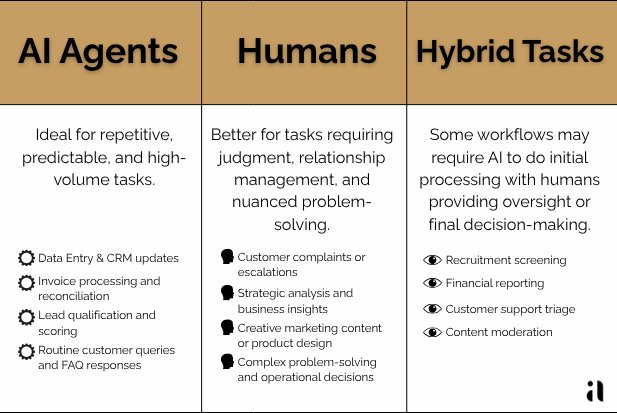
When dividing work between AI agents and human teams, it’s important to consider the nature of the task and where each adds the most value.

AI Agents

Ideal for repetitive, predictable, and high-volume tasks like:

  • Data entry and CRM updates
  • Invoice processing and reconciliation
  • Lead qualification and scoring
  • Routine customer queries and FAQ responses


AI agents excel at handling large volumes of routine work with speed and accuracy. By automating these tasks, businesses reduce human error, free staff from repetitive duties, and ensure operations run efficiently around the clock.

Insight

Within businesses, AI agents are most often deployed in customer service, IT support, finance/admin, and marketing/CRM, freeing human employees to focus on complex, high-value tasks. Employee interactions with AI agents grew by about 65% per month in early-adopter firms during H1 2025.

Human Intervention

Best for tasks requiring judgment, relationship management, and nuanced problem-solving such as:

  • Handling customer complaints or escalations
  • Strategic analysis and business insights
  • Creative work such as marketing content or product design
  • Complex problem-solving and operational decisions


Humans bring contextual understanding, empathy, and critical thinking that AI cannot replicate. These roles benefit from human intuition, relationship-building skills, and the ability to navigate ambiguous or high-stakes situations.

Hybrid Tasks

Some workflows are best handled with AI doing initial processing and humans providing oversight or final decision-making.

  • Recruitment screening: AI shortlists candidates, humans conduct interviews
  • Financial reporting: AI generates draft reports, humans verify and provide insights
  • Customer support triage: AI categorizes tickets, humans manage complex cases
  • Content moderation: AI flags potentially harmful content, humans review edge cases


Hybrid workflows combine the speed and consistency of AI with human judgment, ensuring tasks are processed efficiently while maintaining quality, accuracy, and a human touch where it matters most.

Optimizing AI and Offshore Teams for Maximum Impact

Balancing AI agents with offshore teams is not about replacing humans or blindly automating every task. It’s about creating a hybrid workforce model AI and outsourcing that maximizes efficiency, reduces errors, and frees humans for high-value work.

By carefully mapping workflows, defining responsibilities, and leveraging tools like EOR services for offshore teams, businesses can unlock the full potential of AI while maintaining a motivated, skilled human workforce.

If your business is ready to harness the power of AI agents and offshore teams, start by evaluating which tasks can be automated and which require human expertise. 

Partner with experienced offshore solutions providers and explore AI tools that integrate seamlessly into your workflow to boost productivity, cut costs, and scale your operations efficiently. Take the first step toward a smarter, hybrid workforce today.

Articles You Might Also Like​

Business team holding world map
Business Growth and Strategy
Carolina Castillo

Why Businesses are Moving Remote Back Office Jobs to Asia

More companies are relocating remote back office jobs to Asia as part of a broader strategy to improve efficiency and access global talent. From finance and IT to administration and digital marketing, many operational roles can now be performed remotely without sacrificing quality or control. This article explores why businesses are moving back-office work offshore, which roles are best suited for remote teams, and how companies can manage distributed workforces successfully.

Read More »
Business Growth and Strategy
Carolina Castillo

What SMEs Need to Know About Victoria’s Two-Day WFH Mandate

Victoria’s upcoming two-day WFH rights are set to impact SMEs from September 2026. Employees can work remotely two days a week, but businesses must plan strategically to maintain productivity, team cohesion, and compliance. Discover how hybrid policies, offshore teams, and AI workflows can turn legislative change into a competitive advantage.

Read More »

Leave a Reply

Your email address will not be published. Required fields are marked *