

Operational Intelligence: The New Competitive Advantage for Growing Businesses
Artificial intelligence is no longer a future consideration. It’s already embedded in the way businesses draft documents, analyse data, automate workflows, and communicate with customers.
Yet despite the rapid adoption of AI, many organisations aren’t seeing the transformational productivity gains they expected.
The reason is simple: most businesses are using AI to complete the same work faster, rather than fundamentally improving how work is organised.
A report can now be drafted in minutes instead of hours. Meeting notes are automatically summarised. Emails are written with a single prompt. But if highly skilled professionals are still spending much of their day reviewing administrative work, chasing information, and managing fragmented processes, productivity gains quickly plateau.
For growing businesses, especially professional service firms, operational intelligence is becoming the next frontier of productivity.
What is Operational Intelligence?
Over the past few years, the conversation around AI has evolved rapidly.
First came generative AI, helping people create content, analyse information, and complete tasks faster. More recently, businesses have begun exploring agentic AI—AI systems that can carry out workflows, make decisions within defined parameters, and interact with multiple applications with minimal human input.
But as these technologies become more capable, a new question emerges:
How should AI fit into the way an entire business operates?
At Advice2Talent, we call this Operational Intelligence.
Rather than focusing on individual productivity, Operational Intelligence uses AI to improve how work flows across an organisation. It looks beyond what AI can do and asks:
- Where are bottlenecks slowing the business down?
- Which tasks require human judgement?
- Which activities can be automated or delegated?
- How should work be distributed between AI, support teams, and specialists?
Instead of measuring how busy people are, Operational Intelligence measures whether work is flowing to the right resource at the right time.
For industries like financial advice, accounting, mortgage broking, and other professional services, this represents the next step in AI adoption—not simply using AI to complete tasks faster, but using it to redesign workflows, improve operational visibility, and create capacity across the entire business.
Insight
Generative AI helps people work faster. Agentic AI helps complete work autonomously. Operational Intelligence connects people, AI, and processes to help the entire business work smarter.
AI Is Changing Workflows More Than Workforces
Much of the public discussion around AI focuses on whether jobs will disappear.
In reality, AI is proving far better at replacing tasks than replacing entire roles.
Jobs and Skills Australia estimates that only around 4% of Australian workers are employed in occupations with high automation potential. By comparison, almost 80% work in occupations where AI is more likely to augment human capability than replace it altogether.
Most jobs are made up of dozens of different responsibilities. Some involve structured, repetitive work. Others require communication, judgement, relationship building, creativity, or commercial decision-making.
Instead of eliminating roles, AI is gradually separating routine execution from higher-value decision-making.
When Expertise Gets Buried in Administration
As businesses grow, work rarely stays where it was originally intended. Over time, highly skilled professionals become responsible for far more than the work they were hired to do.
A financial adviser may spend part of the day updating CRM records, reviewing paperwork, coordinating follow-ups, and preparing meeting packs before ever sitting down with a client.
A mortgage broker may devote hours to collecting supporting documents and managing lender portals.
Senior accountants often spend valuable time formatting reports or reconciling data instead of interpreting financial performance and advising clients.
None of these responsibilities are unimportant. In fact, they’re essential to keeping a business running. The question is whether they still belong with your most experienced people.
One of the biggest insights operational intelligence provides is that productivity isn’t only about how much work gets completed – it’s about where expertise is being applied.
When experienced professionals consistently perform work that could be automated, delegated, or supported elsewhere, businesses don’t just lose time.
They lose capacity for higher-value work that drives revenue, strengthens client relationships, and supports long-term growth.
Operational intelligence makes these trade-offs visible by shifting the conversation from “How busy is the team?” to a far more valuable question:
Are our most experienced people spending their time where they create the greatest value?
Redesigning Office Roles for the AI Era
One of the biggest workplace shifts occurring today isn’t workforce reduction. It’s role redesign.
For decades, businesses have organised work around roles, not tasks.
Most jobs were designed so that one person owned an entire process from start to finish.
A financial adviser would prepare for a client meeting, gather documents, review financial information, develop recommendations, conduct the meeting, update internal systems, and follow up afterwards.
A mortgage broker would manage an application through each stage of the lending process.
Administrative work, technical work, and decision-making were bundled into a single role because there was no practical alternative.
This approach reflected how work had always been organised. Much like an assembly line groups related activities into defined stations, knowledge work grouped related responsibilities into job titles. Whoever owned the role owned the workflow.
But AI is challenging that model. Instead of asking, “Who should complete this entire process?” businesses can now ask a more valuable question:
“Who—or what—is best equipped to complete each stage of this workflow?”
That’s an important distinction because not every task requires the same level of expertise. Gathering information is different from interpreting it. Drafting content is different from approving it. Processing data is different from making decisions based on it.
As a result, organisations are beginning to redesign work around capability rather than job descriptions.
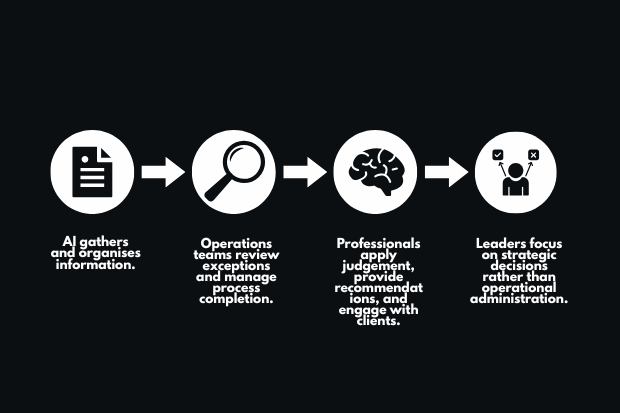
A modern workflow might look like this:
- AI gathers, organises, and prepares information.
- Operations teams review exceptions, complete administrative workflows, and maintain process quality.
- Professionals apply judgement, provide recommendations, and engage with clients.
- Leaders focus on strategy, coaching, and business growth instead of operational administration.
This isn’t about removing people from the process. It’s about ensuring every stage of the workflow is completed by the resource best equipped to perform it.
When businesses stop treating every job as a single, end-to-end responsibility and instead design workflows around the strengths of people, technology, and specialised support, they create more capacity, improve consistency, and scale more efficiently – without necessarily increasing headcount.
Why Operational Intelligence is Becoming a Leadership Capability

As AI becomes embedded in everyday operations, leadership responsibilities are evolving.
Managers are no longer responsible only for managing people.
They’re increasingly responsible for managing the flow of work.
That means understanding:
- where repetitive work accumulates
- where technology can remove unnecessary effort
- where support teams create leverage
- where specialists should spend more of their time
- where operational bottlenecks reduce client experience
In many ways, tomorrow’s highest-performing leaders won’t simply manage teams.
They’ll design systems that allow those teams to perform at their best. This is operational intelligence in practice.
What Operational Intelligence Looks Like in Financial Advice
For Australian financial advice businesses, operational intelligence extends far beyond automating individual tasks.
Advice practices manage complex workflows involving advisers, paraplanners, client service teams, compliance processes, documentation, and ongoing client communication. Small inefficiencies across those functions can quickly compound, reducing adviser capacity and affecting client experience.
Rather than treating AI as another standalone productivity tool, forward-thinking firms are beginning to use it as an operational layer across the business.
That could include:
- identifying workflow bottlenecks before they delay client outcomes
- automating repetitive administrative activities
- improving visibility across operational processes
- streamlining communication between support teams
- surfacing insights that help leaders make better workforce decisions
The objective isn’t simply to complete work faster.
It’s to create a business where work consistently flows to the right person—or the right technology—at the right time.
Operational Intelligence in Action: Meet EVA

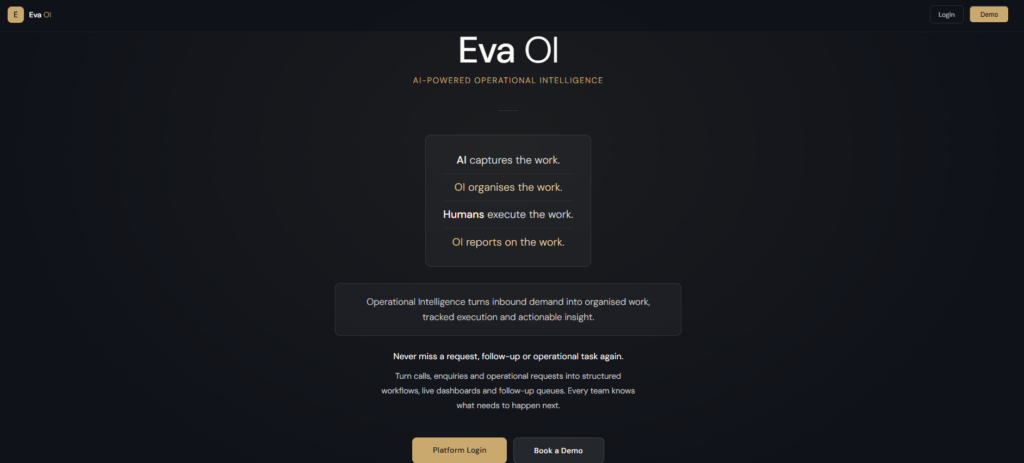
This philosophy is what inspired EVA, Advice2Talent’s AI-powered operational intelligence platform built specifically for Australian financial advice businesses.
Rather than functioning as a general AI assistant, EVA is designed to support the operational side of advice practices.
Working alongside advisers, paraplanners, client service teams, and administrative professionals, EVA helps firms improve workflow visibility, reduce repetitive manual work, and identify opportunities to operate more efficiently.
Combined with Advice2Talent’s experienced offshore and onshore talent solutions, EVA enables firms to build operating models where technology handles routine execution, support teams manage operational processes, and advisers focus on delivering strategic value to clients.
It’s an example of operational intelligence in action—not replacing people, but helping every member of the team work where they contribute most.
Businesses That Win Will Design Better Work
Every major technological shift changes how organisations create value.
AI is no different.
The businesses that gain the greatest advantage won’t necessarily be those with the most AI tools or the largest technology budgets. They’ll be the organisations that rethink how work is structured, redesign roles around human strengths, and use operational intelligence to ensure every task is handled by the most appropriate resource.
Technology can automate execution. People provide judgement. Operational intelligence brings both together.
At Advice2Talent, we help Australian financial advice businesses build smarter operating models through experienced talent, AI-enabled workflows, and EVA, our operational intelligence platform purpose-built for the advice industry.
Because sustainable growth isn’t just about working faster—it’s about designing a business that works smarter.
Articles You Might Also Like

Operational Intelligence: The New Competitive Advantage for Growing Businesses
AI can automate tasks, but Operational Intelligence transforms entire workflows. Discover how businesses are combining AI, people, and smarter processes to unlock capacity, improve efficiency, and gain a lasting competitive advantage.

How AI Will Impact Entry-Level Jobs in Australia
AI isn’t eliminating entry-level jobs—but it is changing how careers begin. Learn how AI is reshaping graduate roles in Australia, the skills employers now value most, and why human judgement is becoming more important than ever.

Why Your Best Employees May Be Burning Out Mid-Year
Burnout isn’t always obvious. Learn why your highest-performing employees are often the most at risk, the warning signs managers miss, and how better workload design can help prevent burnout before it impacts retention and performance.

Should You Change Jobs or Stay Put? Understanding Job Hopping vs Job Hugging
Should you stay with your current employer or look for a new opportunity? This guide explores the differences between job hopping and job hugging, helping professionals make informed career decisions while giving employers valuable insights into employee retention.

Are Your Labour Costs Driving Profit or Inefficiency This EOFY?
Most EOFY conversations focus on tax deductions and refunds. But what if the bigger profitability issue is hiding in your labour costs? Learn how rising employment expenses, administrative bottlenecks, and inefficient team structures may be costing your business more than you realise.

How to Build Team Culture With Offshore and Remote Teams
Building a strong culture with offshore and remote teams takes more than workflows and productivity metrics. From team outings and company events to recognition and connection, discover how businesses can improve engagement, retention, and performance by creating a workplace people genuinely want to be part of.