

Across financial advice, planning, and broking, a familiar pattern is showing up.
Firms are busy. Pipelines are full. Demand is steady.
But behind the scenes, many advisers are stretched thinner than ever—and the work isn’t translating into smoother delivery or better capacity.
More clients haven’t necessarily meant more breathing room. In many cases, it’s meant the opposite.
So the question becomes less about growth, and more about constraint: why financial advisers are overwhelmed in 2026 and what’s actually driving it.
Pressure Points Facing Financial Advisers
At industry gatherings such as the Financial Advice Association Australia (FAAA) Roadshow 2026, the conversation has shifted.
It’s no longer just about strategy updates, regulation, or market outlooks.
A more practical topic keeps coming up: capacity – and whether current firm structures can keep up with demand.
Across sessions and informal discussions between financial advisers, mortgage brokers, and financial planners, a few consistent pressure points come up again and again:
- Workloads are increasing faster than teams can scale
- Client expectations around speed and responsiveness have changed
- Compliance and documentation requirements continue to expand
- A growing share of adviser time is being absorbed by administrative work
Individually, these challenges are manageable. Together, they’re reshaping how advice firms operate day to day and exposing a gap between how firms are structured and what the industry now requires.
Insight
The FAAA Roadshow 2026 spans six capital cities and attracts thousands of advice professionals annually—making it one of the most reliable indicators of industry-wide operational trends, not just theory.
Financial Advisers are Undercapacitated
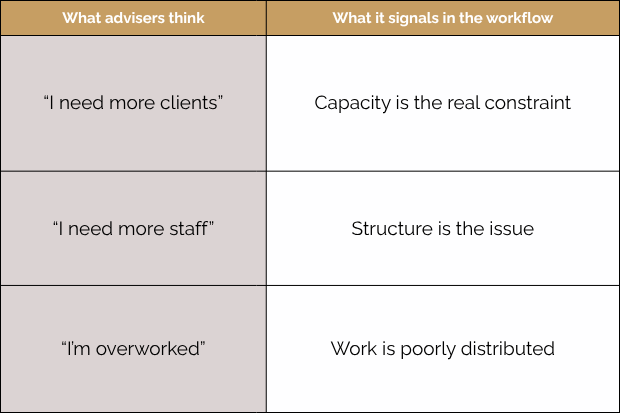
The instinctive answer is that advisers are simply too busy.
But that explanation only describes the symptom, not the cause.
In most firms, the pressure isn’t coming from a lack of effort, it’s coming from how work is structured, distributed, and prioritised across the business.
Demand Has Increased, But So Has Complexity
Client expectations have shifted in a way that directly impacts day-to-day delivery.
They now expect faster turnaround times, more personalised advice, and ongoing engagement rather than periodic check-ins.
At the same time, the advice process itself has become more complex, with increased compliance requirements, documentation standards, and ongoing regulatory obligations.
The result is a compounding effect: more expectations on one side, and more friction in delivery on the other. Even when firms are operating efficiently, the system itself is heavier than it used to be.
High-Value Staff Are Doing Low-Value Work
A less visible but more significant issue is how adviser time is actually being used.
In many firms, advisers are still heavily involved in operational tasks that sit outside core advisory work, including administration, file preparation, CRM management, and coordinating client onboarding processes.
Individually, these tasks seem minor. Collectively, they consume a disproportionate amount of high-value time.
This creates a structural inefficiency: highly qualified professionals spending time on work that does not require their level of expertise, while higher-value advisory work is delayed or compressed.
The Traditional Firm Structure is Reaching Its Limits
Most advice firms are still built around a relatively simple structure: a single adviser supported by one or two generalist support staff.
That model was effective in an environment where compliance was lighter, client expectations were slower, and growth followed a more predictable pattern.
In today’s environment, however, that structure creates a natural ceiling.
Once demand increases beyond a certain point, the model doesn’t scale – it stretches. And when it stretches, it slows everything down across multiple parts of the business, including:
- client onboarding and onboarding coordination
- advice preparation and paraplanning workflows
- responsiveness to client queries and follow-ups
- internal administration and file management
- overall delivery speed from initial enquiry to implementation
Individually, each of these friction points may seem manageable. But together, they compound into delays across the entire advice process, ultimately limiting how many clients a firm can confidently take on without sacrificing service quality.
Capacity Reality Check
Client Onboarding Delays Slowing Down Advice Firms
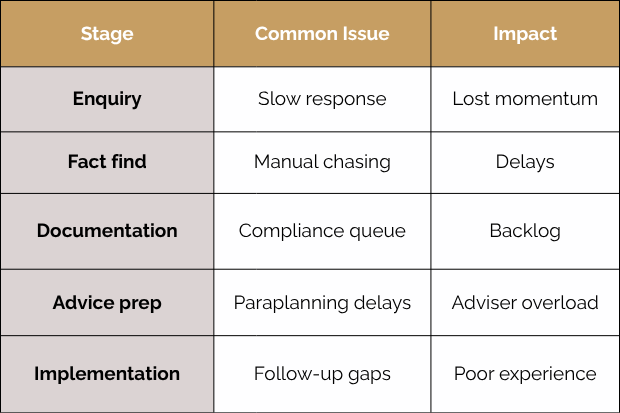
One of the earliest and most visible signs of capacity strain shows up in the onboarding process.
For many financial advisers, mortgage brokers, and financial planners, onboarding is no longer a smooth transition from enquiry to engagement – it’s where momentum starts to slow.
What should be a structured, efficient process often becomes fragmented, with small delays at each step building into a larger bottleneck across the entire client journey.
Common pressure points include:
- slow response times to new enquiries, especially during busy periods
- delays in gathering and verifying client information
- bottlenecks in document preparation and compliance checks
- backlogs in paraplanning and file review before advice can be delivered
These issues rarely exist in isolation. When multiple stages of onboarding are under strain, the effect compounds, turning what should be a straightforward process into a drawn-out experience for both the client and the firm.
Over time, this doesn’t just affect internal efficiency. It impacts client perception, slows revenue realisation, and puts additional pressure on advisers who are already operating at capacity.
How to Increase Capacity in a Financial Advice Firm
Solving capacity is not about working harder or hiring reactively.
It is about redesigning how work flows.
Separate Revenue Work from Operational Work
Advisers should primarily focus on:
- Client strategy
- Relationship management
- Advice delivery
Everything else should be systemised or delegated.
Introduce a Layered Support Model
High-performing firms are moving toward a structured model:
- Adviser (strategy + clients)
- Paraplanning support
- Admin / client service layer
- Operational support (internal or offshore)
Capacity is a Design Problem, Not a Hiring Problem
This is the shift many firms miss.
When pressure builds, the instinct is to hire more people. But if the underlying structure hasn’t changed, the same inefficiencies remain, just spread across more roles.
Instead of increasing capacity, it often adds complexity through unclear ownership, duplicated effort, and more coordination between tasks.
Capacity is not solved by headcount. It’s solved by how work is designed, structured, and moved through the business.
The Role of a Virtual Assistant in Financial Services
A growing number of firms are introducing a virtual assistant for financial services to handle structured, repeatable tasks.
This typically includes:
- CRM management
- Client follow-ups
- Documentation support
- Scheduling and coordination
A virtual assistant for financial advisors is not about replacement—it is about removing friction from daily operations.
Insight
Firms that integrate structured virtual assistant support often report significant reductions in administrative workload within 60–90 days, improving adviser focus and responsiveness.
Why Offshore Financial Planning Support is Growing
Alongside virtual assistants, offshore financial planning support is becoming more widely adopted.
The shift is driven by three factors:
- Talent availability constraints locally
- Cost pressure within advice firms
- Increased acceptance of distributed teams
When structured properly, offshore teams provide:
- Scalable operational capacity
- Consistent execution support
- Extended working hours coverage
How to Reduce Workload for Financial Advisers
Reducing adviser overload isn’t about removing pressure entirely, it’s about shifting it to where it creates value.
In most firms, workload builds because advisers are still tied to repetitive admin, slow onboarding processes, and tasks that don’t require their expertise. Over time, this limits capacity more than client demand ever does.
The real fix is redesigning how work is handled across the business so that operational tasks are absorbed by the right support structure, allowing advisers to stay focused on advice and client relationships.
Fixing Adviser Overwhelm Starts With Structure
The reason why financial advisers are overwhelmed in 2026 isn’t just workload—it’s structure.
Firms that are addressing it are shifting away from adviser-centric models and building capacity-driven teams that allow advisers to focus on advice, not administration.
Because in today’s environment, growth doesn’t come from doing more—it comes from building the systems that let more get done.
If your firm is hitting that capacity ceiling, Advice2Talent helps financial advice businesses and brokerages build offshore and support teams that reduce workload and unlock scalable growth.
Articles You Might Also Like

Why Financial Advisers Are Overwhelmed in 2026 (And How to Fix It)
Financial advisers are busier than ever—but more work isn’t translating into more capacity. This article breaks down the real reasons behind adviser overwhelm in 2026 and how firms can redesign their structure to scale sustainably.

Employee of Record vs Contractor: Which Hiring Model is Right for Your Business?
Choosing between EOR, contractor, direct hire, or freelancer? Learn the key differences, costs, and risks—including contractor misclassification—before you hire.

AI vs Offshore Teams: Which Tasks Should You Automate?
AI can automate tasks, offshore teams add human judgment—but where’s the line? Learn how to split workflows between AI agents and offshore teams for maximum efficiency.

Am I a Contractor or Employee in Australia? Understanding Sham Contracting
Not sure if you’re a contractor or employee? Learn how sham contracting works in Australia, key differences in work arrangements, and what it means for your rights and compliance.

Why Are Some Workers Paid More for the Same Job?
Salary differences often go beyond skill or performance. From labour hire to offshore back-office roles, we break down why some Australian workers earn more for the same job.

Why Businesses are Moving Remote Back Office Jobs to Asia
More companies are relocating remote back office jobs to Asia as part of a broader strategy to improve efficiency and access global talent. From finance and IT to administration and digital marketing, many operational roles can now be performed remotely without sacrificing quality or control. This article explores why businesses are moving back-office work offshore, which roles are best suited for remote teams, and how companies can manage distributed workforces successfully.