


Your First Hire Guide for Financial Advisers

At some point, most financial advisers, mortgage brokers, and planners run into the same constraint: there’s enough demand, but not enough time to keep up with it.

The instinct is often to hire another adviser or broker. But in many cases, that doesn’t solve the core problem.

If your time is still tied up in admin, onboarding, and follow-ups, adding another revenue-generating role can actually increase pressure rather than relieve it.

A more effective first step is understanding where your time is going and what kind of hire will actually free it up.

Where Most Time Gets Lost

In growing advice firms, a large portion of the workload sits in operational tasks. These are essential to running the business but don’t directly generate revenue.

This typically includes:

  • CRM updates and data entry
  • Appointment scheduling and calendar management
  • Document preparation and file organisation
  • Chasing client requirements
  • Managing compliance-related admin


Individually, these tasks seem small. But collectively, they take up hours each week – time that could otherwise be spent on client conversations, strategy, and business development.

If you’re consistently handling these tasks yourself, that’s usually the first bottleneck to address.

Insight

Financial advisers aren’t just managing clients, they’re managing time. Research shows advisers spend only about 50% of their time on client-related activities, and just 20% in actual client meetings. Meanwhile, back-office teams can spend up to 70% of their time on admin-heavy work. Even across professional roles, 5–6 hours per week is often lost to repetitive tasks like data entry and reporting.

Why the First Hire is Usually Not Another Adviser

Man sitting on desk in video conference with man in computer screen
Hiring another adviser too early can increase pressure instead of reducing it.

Hiring another adviser makes sense when there is already enough operational support in place. 

Without that foundation, new advisers still depend on the same admin workflows – and those workflows often fall back on you.

This is why many firms find that their first effective hire is not a revenue generator, but a support role that improves how work flows through the business.

By removing low-value, repeatable tasks from your day, you create the capacity to handle more clients and more opportunities without immediately increasing complexity.

What a First Hire Should Actually Do

The purpose of a first hire is to take ownership of structured, repeatable work.

This doesn’t require deep advisory expertise. It requires consistency, attention to detail, and the ability to follow defined processes.

Typical responsibilities for a first hire include:

  • Maintaining and updating CRM systems
  • Preparing documents and organising client files
  • Managing scheduling and confirmations
  • Following up on outstanding items
  • Supporting compliance and record-keeping processes


These are the tasks that keep the business running, but they don’t need to sit with your highest-value resource.

Myth 4 - Offshore Teams are Only About Cost Savings

Cost is often the entry point into offshore hiring, but it’s rarely the real reason firms stick with it.

The bigger advantage is capacity.

Advisers and brokers often hit a ceiling where growth stalls – not because of lack of demand, but because of limited time. Offshore teams remove that bottleneck by taking over operational work.

This allows you to:

  • Spend more time with clients
  • Increase the number of cases you can handle
  • Focus on revenue-generating activities


While cost is part of the equation, it’s important to understand it in context. Our salary guide shows how offshore roles compare to onshore hiring, but the real takeaway isn’t just lower wages, it’s how those savings translate into additional capacity and output for your business.

Cost savings are a benefit, but scalability is the real value.

Onshore vs Offshore as a First Hire

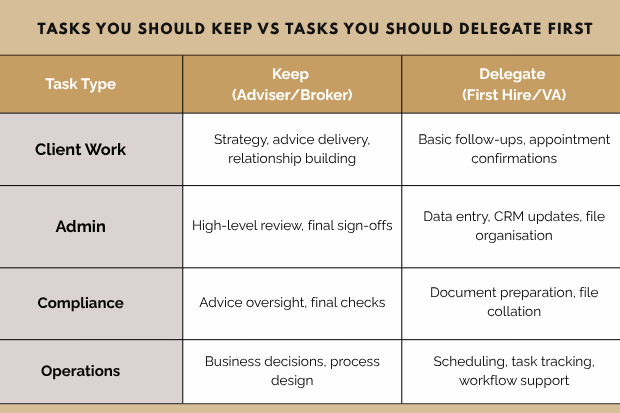
Table of finance tasks to keep or delegate to a virtual assistant
Understanding what to delegate is the first step to building capacity.

One of the key decisions is whether to hire locally or offshore.

Onshore hires offer proximity and may feel more familiar, but they come with significantly higher costs. For many smaller or growing firms, that makes it harder to justify as a first step.

Offshore hiring – particularly through virtual assistants – has become a practical alternative. It allows firms to access skilled support at a lower cost, making it easier to introduce operational roles earlier.

This is especially relevant in financial advice, where many back-office tasks are process-driven and can be done remotely without affecting client outcomes.

For firms that are unsure about hiring, offshore support can also be a lower-risk way to test what works before committing to larger team structures.

When to Make Your First Hire

Bringing someone in doesn’t automatically solve the problem. The effectiveness of your first hire depends on how clearly the role is defined.

This means:

  • Documenting your processes, even at a basic level
  • Being clear about what tasks are being handed over
  • Setting expectations around communication and output
  • Gradually transitioning responsibility, rather than offloading everything at once


The more structured the handover, the faster your first hire becomes productive.

Setting Up Your First Hire Properly

Businesswomen shake hands at group meeting
A well-structured first hire creates the foundation for future growth.

The timing matters. With ongoing regulatory pressure, rising wages, and increased demand for advice, firms are under pressure to do more with less.

Offshore hiring is no longer a fringe strategy – it’s becoming part of how modern advice firms operate.

Those who adopt it strategically are able to scale faster, improve service delivery, and reduce operational strain on their core team.

Those who don’t risk staying stuck in capacity constraints.

What Changes When You Get It Right

When the first hire is aligned with the actual bottleneck in the business, the impact is immediate.

You spend less time on operational tasks and more time on client-facing and revenue-generating work. Turnaround times improve. Capacity increases without needing to expand the team significantly.

Over time, this creates a more scalable structure where additional hires are layered on top of a solid operational foundation, rather than compensating for gaps.

The Right First Hire Frees Up Your Time

Your first hire isn’t just about adding headcount. It’s about changing how work is distributed across your business.

For most financial advisers, the constraint is time spent on tasks that don’t require their expertise.

Addressing that first creates the conditions for sustainable growth.

If you’re considering your next step, start by looking at your own workload. The tasks you repeat every day are usually the ones someone else should own.

If cost is part of your decision, using a salary guide can help you benchmark different hiring options – whether onshore or offshore – and understand what level of support makes sense for your current stage.

Articles You Might Also Like​

Leave a Reply

Your email address will not be published. Required fields are marked *