



Advice2Talent

Are Filipino Virtual Assistants Good for Australian Businesses?

As Australian companies continue to scale in an increasingly global workforce, one question comes up repeatedly: are Filipino virtual assistants good for Australian businesses?

The short answer is yes, and the reasons go far beyond cost savings.

From strong cultural alignment to practical time-zone overlap and long-term workforce stability, Filipino virtual assistants have become a preferred offshore solution for Australian SMEs, recruiters, and growing enterprises. 

This article explores why that is the case, how the Australia–Philippines working relationship functions in practice, and why the Philippines is often considered the best country to hire virtual assistants for Australia.

Why Australian Companies are Looking Offshore

Diverse employees on videocall with remote workers
Labour shortages and rising costs are driving Australian businesses offshore. Filipino VAs provide scalable support with strong outcomes across communication, retention, and productivity.

Labour shortages, rising local employment costs, and the need for scalable support have pushed many Australian businesses to explore offshore hiring. 

Virtual assistants, in particular, allow companies to extend operational capacity without the overheads of onshore expansion.

While there are many countries offering virtual assistant services, Australian company hiring Filipino professionals consistently report stronger outcomes across communication, retention, and productivity.

This is not accidental. The Philippines has spent decades building a workforce aligned with Western business standards, especially in industries servicing Australia, the US, and the UK.

Did you know?

Infrastructure Australia now projects a 300,000-worker shortfall by 2027, up from around 141,000 today, with regional shortages forecast to quadruple. This talent gap stretches across industries, including administrative and operational roles, making offshore solutions like Filipino virtual assistants an increasingly strategic choice for Australian businesses.

Why Hire Filipino Virtual Assistants Over Other Countries

When comparing offshore destinations, Australian employers often look at countries such as India, Vietnam, Eastern Europe, and parts of Latin America.

Cost is often similar across these regions. What differs is how well the talent integrates into Australian teams.

This is where Filipino virtual assistants consistently stand out. The advantage goes beyond affordability.

When the goal is not just to save money, but to build a team that feels like a true extension of your local workforce, the Philippines offers a uniquely strong match for Australia.

Hours Gap Between Australia and the Philippines

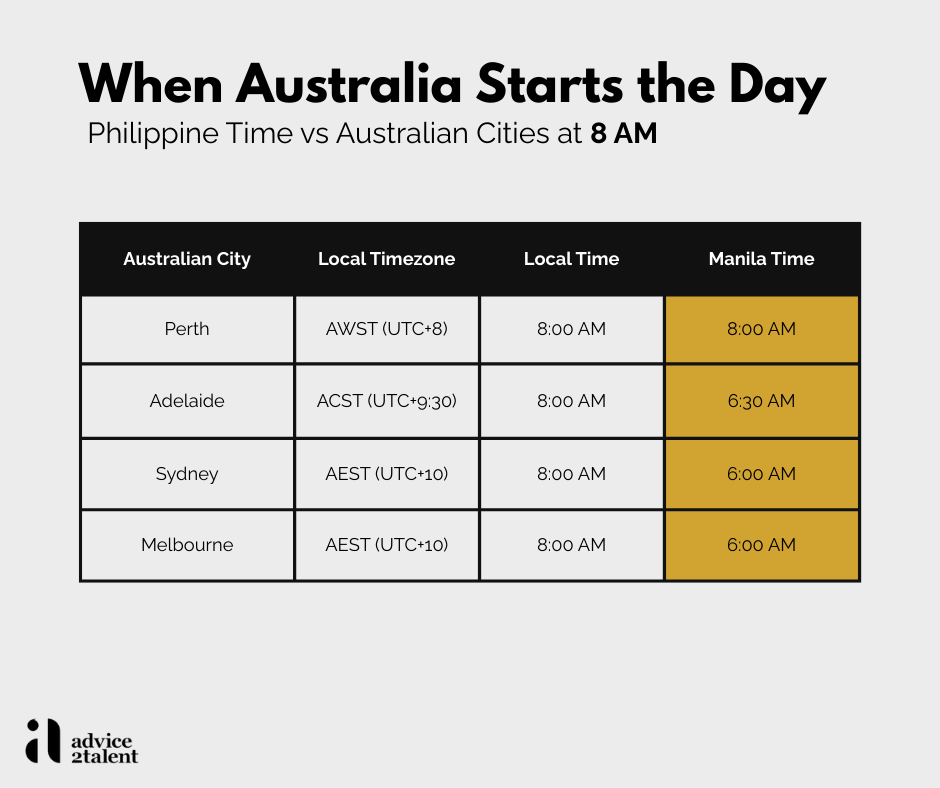
Manila vs Australian cities (standard time)
The Philippines is 2–3 hours behind most Australian states, offering significant overlap for seamless collaboration without early mornings or late nights.
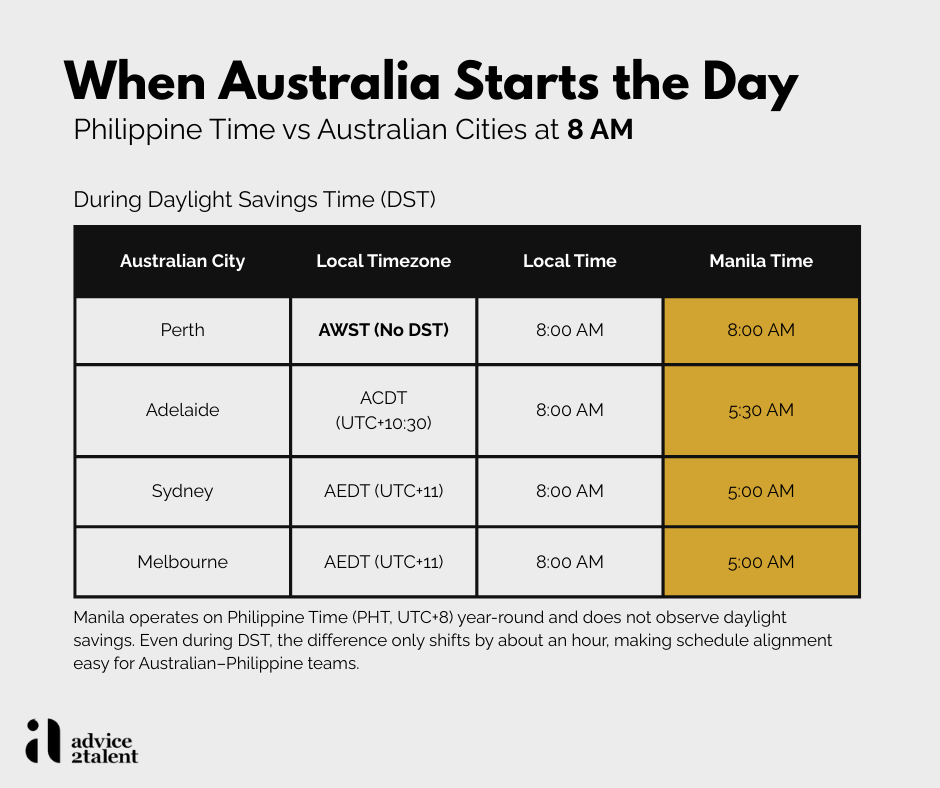
Manila vs Australian cities during DST
Even during daylight savings in NSW, VIC, SA, TAS, and ACT, the time difference remains manageable, letting businesses operate efficiently year-round.

A common concern for employers considering offshore staff is time-zone compatibility.

Fortunately, the hours gap between Australia and the Philippines is relatively small compared to other offshore destinations.

Depending on the state and daylight savings:

  • The Philippines is typically 2 to 3 hours behind Australia
  • There is substantial overlap with standard Australian business hours


During daylight savings time, which is observed in New South Wales, Victoria, South Australia, Tasmania, and the Australian Capital Territory, the gap shifts slightly. 

Even so, the difference is minimal, allowing Australian businesses to operate as usual with little to no disruption.

Strong English Proficiency

English is an official language in the Philippines and is widely used in education, business, and professional environments. 

The country produces around 600,000 tertiary graduates each year, including over 3,000 accountants, giving Australian businesses access to a large pool of highly educated and skilled talent. 

Many Filipino virtual assistants are trained to work with international clients, speak English fluently, and understand professional expectations, which reduces miscommunication, shortens onboarding, and improves day-to-day collaboration.

Cultural Alignment With Australian Workplaces

Australian businesses value initiative, accountability, and team collaboration. Filipino professionals are widely recognised for their adaptability, strong work ethic, and service-oriented mindset. 

These cultural traits align closely with Australian workplace values, making integration smoother than in many other offshore markets.

Are Filipino Virtual Assistants Good for Australian Businesses Long Term?

Across the Australian workforce, job mobility is slowing. 

In the year to February 2025, the job mobility rate fell to 7.7%, and while younger workers remain more fluid, over half of employed Australians have now been in their role for less than five years. 

Only one in ten has stayed in the same job for two decades or more. What this reflects is a broader shift: people are still moving, but they are doing so more carefully. Stability is becoming a differentiator.

This is where Filipino virtual assistants stand out.

While some offshore markets struggle with rapid churn, many Filipino professionals actively seek long-term, stable employment. 

They are often motivated by career progression, consistent working relationships, and professional growth rather than short-term contract hopping.

When structured correctly, offshore roles can also align with Australian expectations around fairness and accountability. 

Reputable providers operate within Philippine labour laws while mirroring the intent of frameworks like Fair Work Australia prioritising ethical pay, clear working conditions, and sustainable employment practices. This creates stability for workers and confidence for employers.

For Australian businesses, this translates into:

  • Lower replacement costs
  • Stronger institutional knowledge
  • Better continuity across projects and clients


This long-term mindset, combined with ethical employment structures, is a major reason the Philippines is frequently cited as the best country to hire virtual assistants for Australia.

Did you know?

Versus 8-12% Australian employee churn, VA retention yields 70-80% lower replacement costs ($0-2k vs $20k+), ideal for finance outsourcing. Gen Z VAs (20-35) further stabilize teams with digital savvy and work ethic.

Australia–Philippines Overlapping Work Hours in Practice

Australian clients meeting with virtual assistant video call
Filipino VAs align their schedules with Australian business hours. Those commuting avoid peak traffic, while home-based VAs enjoy flexible end-of-day schedules for errands or appointments.

As mentioned earlier, one of the biggest operational advantages is the ease of synchronising schedules. Many Filipino virtual assistants work:

  • Full Australian business hours
  • Partial overlapping shifts
  • Flexible hybrid schedules aligned to client needs


This makes meetings, handovers, and real-time collaboration achievable without requiring either side to work unusual hours. 

For VAs and BPO staff who travel to offices in Metro Manila, Australian shifts are especially convenient as starting earlier allows them to avoid the city’s main peak traffic times. 

For home-based VAs, the earlier end to their workday provides additional flexibility. They can visit government offices, go to the bank, or run errands that need to be done before 4 p.m..

For businesses concerned about Australian working hours in the Philippines, it is standard practice for offshore staff to align their schedules accordingly, especially when supporting Australian teams.

Managing Time Zone Differences

Even with strong overlap, effective coordination still matters. Australian companies that succeed with offshore teams typically establish clear expectations around availability, handover processes, and communication channels.

Best practices for managing time zone differences Australia–Philippines working arrangements include:

  • Setting fixed overlapping hours for meetings
  • Using shared project management tools
  • Establishing clear response-time expectations
  • Documenting processes to reduce reliance on real-time input

When managed properly, working across time zones Australia–Philippines business operations becomes a strategic advantage rather than a challenge.

Operational Advantages for Australian Businesses

Beyond talent and time zones, Filipino virtual assistants offer practical business benefits that make scaling easier.

Cost Efficiency Without Compromising Quality

Hiring offshore allows Australian companies to access highly skilled professionals at a significantly lower cost than onshore roles, without sacrificing performance or professionalism. 

The savings created can be reinvested into growth, technology, or building larger, more capable teams.

For businesses curious about what this actually looks like in practice, our VA Salary Guide breaks down real-world pay ranges, role types, and cost comparisons, so you can see exactly how much you’ll spend (and save) when hiring seasoned Filipino virtual assistants. 

It’s designed to bring transparency to offshore hiring and help you plan with confidence.

Scalability and Flexibility

Woman in video conference at home office
From one assistant to full offshore teams, Filipino VAs provide flexible, skilled support across administration, customer service, finance, marketing, IT, and operations.

Whether you need one assistant or an entire offshore team, the Philippines offers a deep talent pool across administrative support, customer service, finance, marketing, IT, and operations. This makes it easier to scale teams up or down as business needs evolve.

Why the Philippines Remains the Smartest Choice

So, are Filipino virtual assistants good for Australian businesses? The evidence points clearly in one direction.

Many Filipino VAs sit outside the high-churn, early-career bracket that drives turnover in many onshore roles. They are more likely to be mid-career professionals seeking stability, long-term clients, and consistent income. 

The result is fewer resets, stronger institutional knowledge, and teams that compound in value over time rather than restarting every year.

Australian companies continue to choose the Philippines because it offers:

  • Strong English communication
  • Cultural compatibility
  • Reliable long-term staff
  • Practical time-zone alignment
  • Cost-effective, scalable workforce solutions


Just as importantly, who you partner with matters. At Advice2Talent, we operate as an ASIC-compliant offshore service provider, ensuring our structures, contracts, and employment practices align with Australian regulatory expectations. 

This gives businesses confidence that offshore hiring can be done ethically, transparently, and responsibly.

For organisations seeking offshore support that truly feels like an extension of their local team, not a risk or a workaround, the Philippines, paired with the right partner, consistently delivers better outcomes than many alternative markets.

Making Offshore Hiring Work for Your Business

Success with offshore hiring is not just about choosing the right country, but it is about choosing the right structure, support, and partner.

Australian businesses that invest in proper onboarding, clear expectations, and ethical employment practices see the strongest results from their Filipino virtual assistants.

With the right approach, offshore hiring becomes less about outsourcing tasks and more about building a dependable, long-term workforce that supports sustainable growth.

Articles You Might Also Like​

Business Growth and Strategy
Carolina Castillo

Are Filipino Virtual Assistants Good for Australian Businesses?

Filipino virtual assistants aren’t just cost-effective, they bring strong English proficiency, cultural alignment, and long-term stability. This guide explores how Australian businesses can leverage offshore talent to boost productivity, reduce turnover, and scale sustainably.

Read More »
male and female employee on racetrack
Virtual Assistants and Remote Work
Carolina Castillo

Should I Look for a New Job Now? Key Tips for 2026

January sparks reflection for many professionals. Should you change roles now, or prepare first? This guide helps you decide, position yourself strategically, and explore career options—including remote and offshore opportunities.

Read More »
Virtual Assistants and Remote Work
Carolina Castillo

How to Retain Virtual Assistants Before They Get Burned Out

High VA turnover disrupts workflows and slows growth—but most departures are preventable. Learn why virtual assistants leave and how Australian businesses can retain talent through structured onboarding, clear communication, intentional workload management, and career growth opportunities.

Read More »
Virtual Assistants and Remote Work
Carolina Castillo

Why Holiday Leaves for Offshore Workers Matter to Your Team

Supporting holiday leaves for offshore teams isn’t just time off — it’s key to motivation, trust, and consistent performance. Learn how fair pay, clear policies, and respect for cultural priorities strengthen remote team productivity.

Read More »
Company Insights
Carolina Castillo

Is Your Offshore Provider ASIC Compliant?

Confused about ASIC’s offshore outsourcing requirements? This post breaks down exactly what offshore providers for finance firms need to do to maintain compliance, reduce risk, and build efficient, well-supervised global teams.

Read More »

Leave a Reply

Your email address will not be published. Required fields are marked *