



As Australian businesses wind down for the holidays, many leaders assume that recruitment can wait until January.
But what most don’t realise is that by the time the new year arrives, the advantage has already shifted to companies that prepared earlier.
January may be one of the busiest months for hiring, but it’s also the period when competition peaks, candidate availability becomes more volatile, and recruitment teams face the heaviest operational backlogs.
Meanwhile, the organisations that began building their talent pipelines in November and December have already pre-screened candidates, secured interviews, and often filled key roles before their competitors are even back from the break.
If your business expects to scale in early 2026—whether through local recruitment or offshore hiring—understanding this dynamic is critical.
Companies that stay proactive before the holidays enter January with stronger candidates, faster turnaround, and significantly less friction throughout the hiring process.
This guide breaks down why waiting until January puts businesses behind, what market conditions to expect, which industries will see the most hiring activity, and how early preparation creates a genuine competitive advantage.
Why So Many Australian Companies Hire in January
Several operational and market factors create a predictable and often intense January hiring surge each year. For 2026, early indicators suggest this momentum will be stronger than usual.
Budget Resets and New Projects
By early January, new budgets are approved, new projects commence, and deferred roles from Q4 are finally released.
Throughout November and December, many positions are placed on hold due to year-end constraints, only to reappear in the first or second week of January.
Increased Employee Turnover
Workers often reassess their career plans over the holidays, leading to a noticeable uptick in resignations.
This creates immediate backfill needs and contributes significantly to the hiring rush that recruiters confront at the start of the year.
Insight
According to Jobs and Skills Australia in their January 2024 REOS Recruitment Experiences and Outlook Survey, nearly half of Australian employers (48%) recruited staff, a slight increase from December, yet over half of recruiting employers (56%) were unable to fill vacancies within a month, with smaller businesses and higher-skilled positions experiencing the greatest difficulty.
Higher Candidate Activity
Talent availability increases in January. Candidates who paused their job search during December become active again, leading to spikes in applications, stronger engagement, and faster movement through pipelines.
This surge supports both local and offshore recruitment, particularly for roles that require rapid scaling.
The Job Market in January and What Recruiters Can Expect
Recruiters and hiring managers can prepare for several January-specific dynamics, especially when hiring for Australian teams or building offshore capability.
Increased Competition for Talent
With so many organisations opening roles at the same time, competition intensifies. Top talent rarely stays available for long. Even for offshore roles, demand increases sharply, particularly among Australian, US, and UK companies pursuing similar candidate profiles.
Higher Application Volume
While volume is beneficial, it can pressure recruitment teams. Without a structured sourcing and screening process in place beforehand, applications can pile up and slow down time-to-fill.
Delays Caused by Holiday Backlogs
Even when companies are ready to hire, the return-to-work transition often creates operational delays.
Hiring managers may still be clearing holiday workload, catching up on emails, and managing approvals, all while employees exercise their right to disconnect from work communications.
This is why businesses benefit from preparing pre-holiday. Streamlined processes and pre-screened talent pools significantly improve speed and reduce the risk of losing candidates to faster-moving competitors.
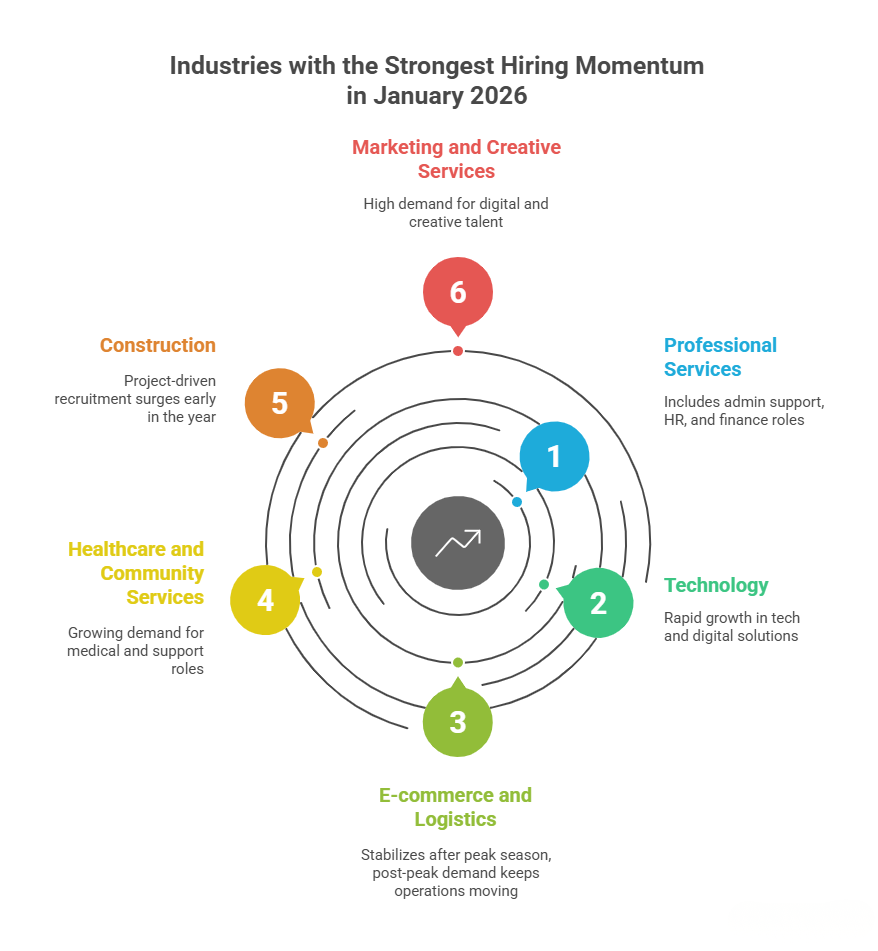
Industries Hiring Most in January 2026
Based on current patterns and projected growth, the following industries are expected to experience stronger hiring momentum at the start of the year:
- Professional services, including admin support, HR, and finance
- Technology, digital, and IT support roles
- E-commerce and logistics, which stabilise after peak season
- Healthcare and community services
- Construction, engineering, and infrastructure
- Marketing and creative services, particularly digital-focused roles
For offshore teams, these trends are even more defined. The January hiring surge for offshore teams tends to be more pronounced due to increased movement in Business Process Outsourcing (BPO) environments and the return of candidates who waited for year-end bonuses before switching employers.
Insight
Offshore markets experience their own January rush. Many BPO employees wait until after receiving year-end bonuses before resigning, creating a wave of high-quality talent available from early to mid-January. Recruiters and employers should be vigilant of this phenomenon to secure the best candidates before competitors move.
Preparing for the Hiring Surge
Whether your organisation is targeting local hires, expanding your offshore workforce, or a mix of both, early preparation is essential. Below are strategies that help companies stay ahead during the January hiring surge.
Build Your Pipeline Before the Break
December is quieter, but this is an advantage. It’s an ideal period to gather CVs, pre-screen candidates, and prepare shortlists. This ensures that interviews can begin immediately once team members return.
Insight
Offshore markets experience their own January rush. Many BPO employees wait until after receiving year-end bonuses before resigning, creating a wave of high-quality talent available from early to mid-January. Recruiters and employers should be vigilant of this phenomenon to secure the best candidates before competitors move.
Standardise and Tighten Recruitment Processes
During a high-volume month like January, slow or overly complex processes lead to significant candidate drop-off. Clear communication, straightforward assessment steps, and prompt decision-making help maintain candidate engagement.
Set Headcount, Timelines, and Budget Early
Avoid the bottleneck that occurs when teams wait for confirmations in January. Companies that align expectations early reduce delays and can move more decisively in the first weeks of the year.
Strengthen Offshore Recruitment Capacity
Offshore hiring continues to grow among Australian SMEs due to scalable talent pools and cost efficiency. However, competition is increasing, which means early preparation is crucial.
This is also an opportunity to revisit common misconceptions, especially when addressing offshoring myths that prevent companies from fully leveraging overseas talent.
Prepare Onboarding and Internal Systems in Advance
Recruitment is only half the process. Smooth onboarding is what ensures productivity and retention. This includes setting up systems, documentation, training plans, and workload distribution.
Building onboarding structures early in December also aligns with broader people strategies, especially for organisations exploring future-proofing your workforce initiatives.
Planning Around Holiday Realities
One factor many companies overlook is the operational slowdown caused by holiday leave schedules.
Understanding how holiday leaves affect both Australian and offshore teams helps you manage timelines and avoid recruitment delays.
Teams that plan around reduced availability in late December and early January reduce friction and start the year with stronger momentum.
Secure the Talent You Need in January 2026
January remains one of the strongest and most competitive months for recruitment across Australia and the offshore market.
Companies hiring in January consistently gain access to larger talent pools, more active candidates, and stronger opportunities to fill roles quickly.
But with demand high and global competition rising, success depends on preparation.
Businesses that build their pipelines early, streamline processes, and strengthen offshore hiring capability enter the new year with a clear operational advantage.
If your organisation wants to secure top talent, reduce recruitment friction, and start 2026 with a future-ready workforce, Advice2Talent can help you plan, source, and hire the right people — onshore or offshore — with confidence and speed.
Connect with our team today to begin building your January hiring strategy.
Articles You Might Also Like

Why Are Some Workers Paid More for the Same Job?
Salary differences often go beyond skill or performance. From labour hire to offshore back-office roles, we break down why some Australian workers earn more for the same job.

Why Businesses are Moving Remote Back Office Jobs to Asia
More companies are relocating remote back office jobs to Asia as part of a broader strategy to improve efficiency and access global talent. From finance and IT to administration and digital marketing, many operational roles can now be performed remotely without sacrificing quality or control. This article explores why businesses are moving back-office work offshore, which roles are best suited for remote teams, and how companies can manage distributed workforces successfully.

What SMEs Need to Know About Victoria’s Two-Day WFH Mandate
Victoria’s upcoming two-day WFH rights are set to impact SMEs from September 2026. Employees can work remotely two days a week, but businesses must plan strategically to maintain productivity, team cohesion, and compliance. Discover how hybrid policies, offshore teams, and AI workflows can turn legislative change into a competitive advantage.

Red Flags in Offshore Outsourcing Contracts
Offshore outsourcing agreements can contain hidden clauses that restrict hiring, increase costs, and create long-term dependency. This practical checklist highlights the contract red flags every business should review before signing with an offshore provider.

Fixing The Pay Gap in Offshore Hiring
If clients are paying premium offshore rates, why are many virtual assistants still underpaid? This case study explores how hidden pay gaps form, the risks they create, and how transparent pay structures can protect both businesses and offshore professionals.

Don’t Let Payroll Mistakes Hurt Your Business
Payroll errors can cost your business money, trust, and legal trouble. Discover the most common payroll mistakes to avoid—and how payroll virtual assistants can keep payments accurate, compliant, and stress-free.
2 Responses