


Employee of Record vs Contractor: Which Hiring Model is Right for Your Business?
Every time your business needs a new hire, the same question comes up: what’s the right way to engage them?
Do you bring them on payroll, work with a contractor, or hire internationally without setting up an entity?
Understanding the difference between an employee of record vs contractor model – and how both compare to direct hires and freelancers – is critical. The wrong choice can lead to unnecessary costs, compliance issues, or even legal exposure.
This guide breaks down the four most common workforce models for startups and growing businesses, so you can make the right call based on speed, cost, and risk
Employer of Record (EOR)
An Employer of Record is a third-party company that legally employs workers on your behalf. You direct the work, the EOR handles the employment contract, payroll, taxes, benefits, and local labor law compliance.
How EOR works
You partner with an EOR provider. They hire your chosen candidate in the target country under their entity. You pay the EOR a fee (usually a markup on the worker’s salary), and they pass compensation through to the employee. To the worker, the EOR is their employer of record—but day-to-day, they report to you.
When to Use EOR
- Expanding into a new country without setting up a legal entity
- Hiring remote talent in jurisdictions where you have no presence
- Testing a market before committing to a full local subsidiary
- Needing speed: EOR can onboard a worker in days vs. months for entity setup
EOR Pros
Fast global hiring, full compliance offloaded, no local entity needed, employee gets full benefits
EOR Cons
Ongoing markup cost (typically 15–25% above salary), less control over HR policies, dependent on the EOR provider’s quality.
EOR Cost Structure
EOR fees are typically charged as a percentage of gross salary or a fixed monthly fee per employee. Expect $300–$600/month per employee on top of salary for international hires, depending on the country and provider.
Direct Hire (Full-Time Employee)
A direct hire is a traditional, permanent employment relationship. The worker is on your company’s payroll – you are the legal employer, responsible for all obligations.
How Direct Hires Work
You recruit, offer, and onboard the employee directly. They appear on your payroll, receive your benefits package, and are governed by the employment laws of their jurisdiction. You own the full relationship: HR, performance management, termination.
When to Use Direct Hires
- Building a core team that carries institutional knowledge
- Roles requiring deep alignment with company culture and long-term ownership
- You have the HR infrastructure to support permanent employees
Direct Hire Pros
Strong employer-employee relationship, highest cultural integration, full control over HR, clear IP ownership.
Direct Hire Cons
Slowest to hire, highest ongoing cost (salary + benefits + employer taxes + overhead), significant compliance burden, hardest to exit.
Direct Hires Cost Structure
Total employment cost is typically 1.25–1.4x the base salary when you factor in employer payroll taxes, benefits, equipment, office space, and administrative overhead. Build this into your hiring budget.
Contractor (Independent Contractor / B2B)
A contractor is a self-employed individual or company that provides services to your business on a defined engagement. There is no employment relationship—it is a business-to-business (B2B) arrangement governed by a services agreement.
How Contractors Work
You engage a contractor through a Statement of Work (SOW) or Master Services Agreement (MSA). They invoice you for their services. They handle their own taxes, insurance, and benefits.
The key distinction from employment: contractors control how they do the work, not just what they deliver.
When to Use a Contractor
- You have a specific, time-bound project with clear deliverables
- You need deep expertise that doesn’t exist in-house
- Budget is project-based rather than recurring
- You want flexibility to scale up or down without headcount implications
Contractor Pros
Access specialized skills without permanent overhead, faster engagement, no employer tax obligations, project-scoped cost.
Contractor Cons
Misclassification risk if treated like an employee, less control over working methods, no guarantee of availability, IP ownership must be explicitly contracted.
Contractor Misclassification Risk
One of the biggest risks with this model is independent contractor misclassification.
If a contractor works like an employee—follows your schedule, uses your tools, and operates under your direction—regulators may classify them as an employee.
This creates serious contractor misclassification risk, especially in jurisdictions with strict labor laws. The consequences of independent contractor misclassification can be significant:
- Back payment of wages and benefits
- Unpaid taxes and penalties
- Legal disputes and reputational damage
These independent contractor misclassification risks are one of the main reasons businesses turn to EOR solutions instead
Freelancer
A freelancer is a self-employed individual who works on a task or project basis—typically shorter engagements, more transactional, and sourced through platforms or personal networks. Legally, freelancers are independent contractors, but the working relationship tends to be more flexible and project-specific.
How Freelancers Work
You find a freelancer via platforms (Upwork, Toptal, Fiverr, LinkedIn) or referrals, agree on scope and rate, and they complete the work. Engagements can be as short as a few hours or as long as several months, but the framing is task-oriented rather than role-oriented.
When to Use a Freelancer
- One-off tasks: design, copywriting, development sprints, video editing
- You need work done fast with minimal onboarding
- Budget is tight and you only pay for what gets delivered
- Testing a type of work before committing to a role or contractor
EOR Pros
Maximum flexibility, fast access to talent, pay-per-deliverable model, global talent pool at competitive rates.
EOR Cons
Less accountability than employees or formal contractors, quality varies widely, not suitable for ongoing or strategic work, same misclassification risks apply.
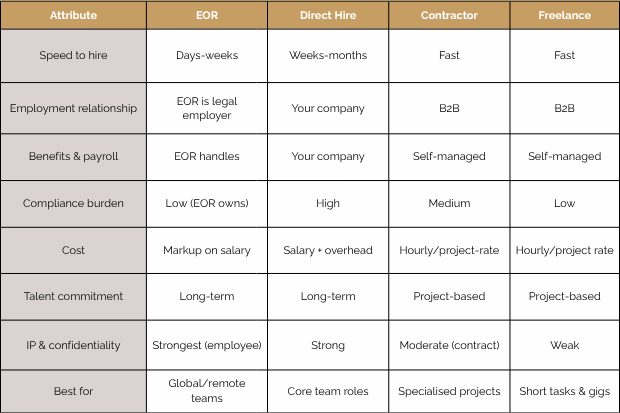
Side-by-Side Comparison
Use this table as a quick reference when evaluating which model fits your next hire:
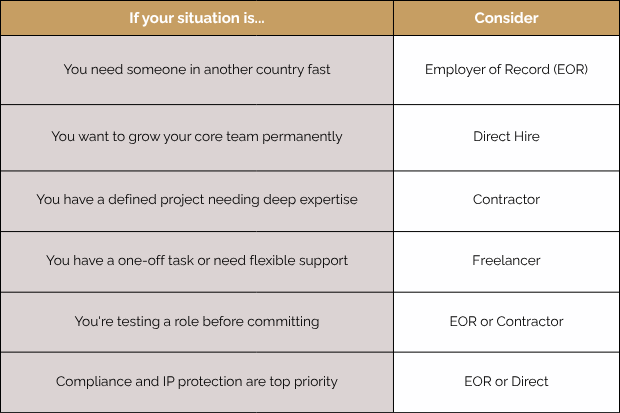
Side-by-Side Comparison
Answer the question: What am I actually trying to achieve? Then match your situation below.
Understanding the True Cost of Hiring Models
Founders often compare a contractor’s hourly rate to an employee’s salary and conclude contractors are more expensive.
That comparison is misleading. When you hire an employee, you absorb employer taxes, benefits, PTO, equipment, management overhead, and the cost of a bad hire.
Contractors and freelancers price risk and overhead into their rates—you pay more per hour but far less in total cost of ownership for scoped work.
Similarly, EOR fees look expensive on paper, but they eliminate the cost of entity setup ($10k–$50k+), ongoing local HR and legal costs, and the liability of getting compliance wrong in an unfamiliar jurisdiction.
The right model is rarely the cheapest per-hour—it’s the one that gets the work done at the right quality with the least risk for your current stage.
Making the Right Hiring Decision
There is no universally right answer. Most scaling businesses use all four models simultaneously: direct hires for the core team, EOR for international expansion, contractors for specialized projects, and freelancers for on-demand work.
The key is being intentional. Define the work, the timeline, the compliance context, and the budget before you decide how to engage talent.
Getting that decision right early saves significant time, money, and legal headache down the road.
Articles You Might Also Like

Employee of Record vs Contractor: Which Hiring Model is Right for Your Business?
Choosing between EOR, contractor, direct hire, or freelancer? Learn the key differences, costs, and risks—including contractor misclassification—before you hire.

AI vs Offshore Teams: Which Tasks Should You Automate?
AI can automate tasks, offshore teams add human judgment—but where’s the line? Learn how to split workflows between AI agents and offshore teams for maximum efficiency.

Am I a Contractor or Employee in Australia? Understanding Sham Contracting
Not sure if you’re a contractor or employee? Learn how sham contracting works in Australia, key differences in work arrangements, and what it means for your rights and compliance.

Why Are Some Workers Paid More for the Same Job?
Salary differences often go beyond skill or performance. From labour hire to offshore back-office roles, we break down why some Australian workers earn more for the same job.

Why Businesses are Moving Remote Back Office Jobs to Asia
More companies are relocating remote back office jobs to Asia as part of a broader strategy to improve efficiency and access global talent. From finance and IT to administration and digital marketing, many operational roles can now be performed remotely without sacrificing quality or control. This article explores why businesses are moving back-office work offshore, which roles are best suited for remote teams, and how companies can manage distributed workforces successfully.

What SMEs Need to Know About Victoria’s Two-Day WFH Mandate
Victoria’s upcoming two-day WFH rights are set to impact SMEs from September 2026. Employees can work remotely two days a week, but businesses must plan strategically to maintain productivity, team cohesion, and compliance. Discover how hybrid policies, offshore teams, and AI workflows can turn legislative change into a competitive advantage.